
EPA 2027 Diesel Engine Requirements: 7 Changes Fleets Need to Prepare For
EPA 2027 diesel engine requirements will sharply reduce allowable nitrogen oxide emissions from new heavy duty engines while expanding the range of operating conditions under which those engines must remain compliant.
For fleets, the result should be the cleanest diesel engines produced in the United States so far.
It will not mean the end of diesel particulate filters, selective catalytic reduction systems, regeneration problems, sensor failures, or aftertreatment maintenance.
In fact, the opposite may be true.
The new engines will depend on faster catalyst heating, tighter temperature control, more precise sensor data, stronger electrical systems, and closer coordination between the engine and aftertreatment system.
That gives fleets a simple choice.
They can prepare their maintenance and diagnostic practices for the next generation of diesel technology, or they can wait until the first truck enters a derate and begin learning under pressure.
What Are the EPA 2027 Diesel Engine Requirements?
The EPA 2027 heavy duty engine standards reduce allowable NOx emissions, expand testing across more operating conditions, and require emissions systems to remain effective for longer portions of an engine's operating life.
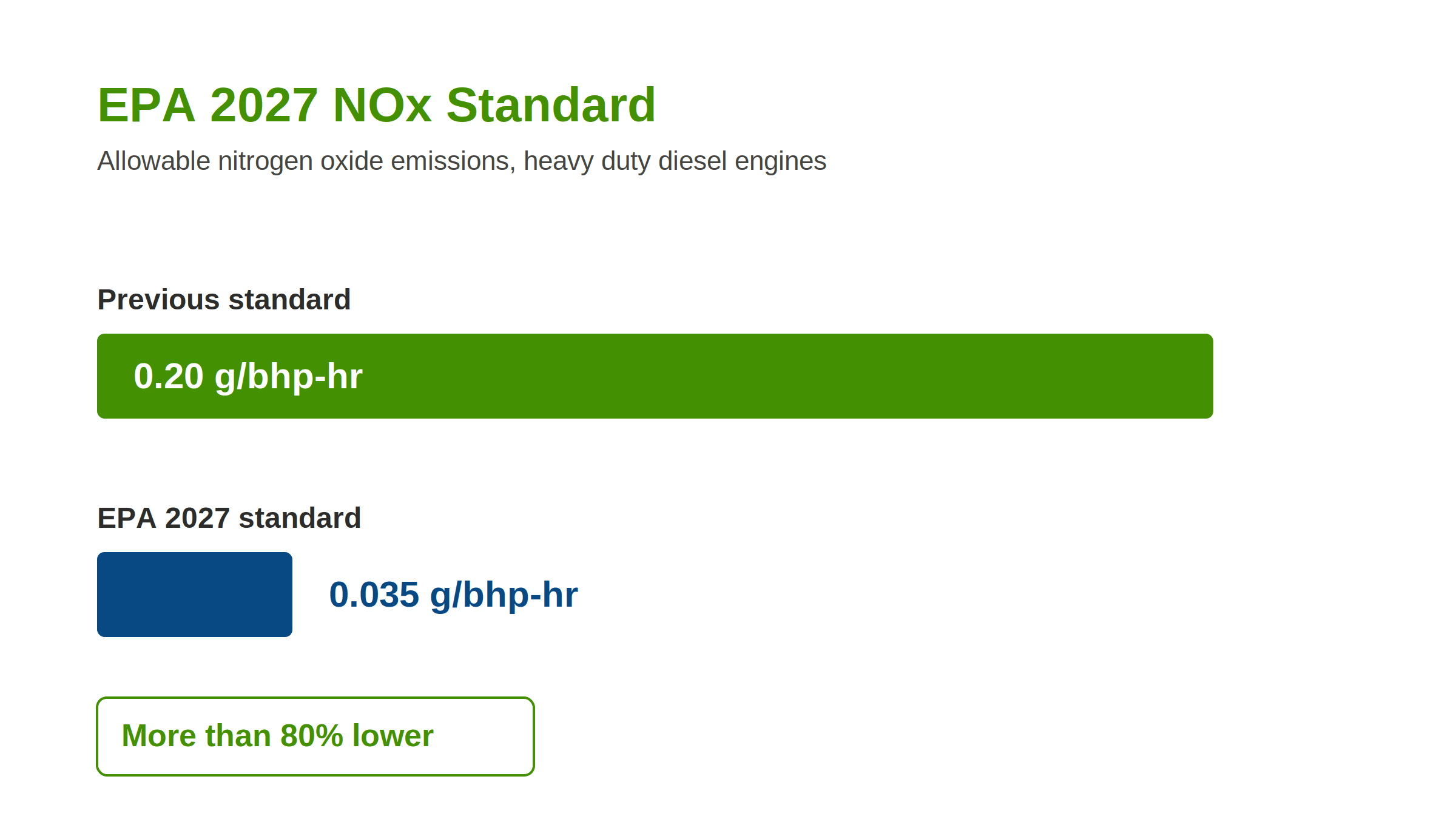
The primary NOx limit for model year 2027 heavy duty engines is 0.035 grams per brake horsepower hour. The previous standard was 0.20 grams per brake horsepower hour.
That represents a reduction of more than 80 percent in the applicable NOx standard.
The regulation also focuses more heavily on emissions produced during conditions that have traditionally been difficult for diesel aftertreatment systems, including:
- Cold starts
- Low load operation
- Extended idling
- Stop and go driving
- Short trips
- Lower exhaust temperatures
- Real world operation outside traditional certification cycles
EPA adopted the original rule in December 2022, with the requirements beginning in model year 2027. The rule expands the range of operating conditions covered by the standards and includes stronger durability and compliance provisions.
However, some ownership related provisions are still being reconsidered.
On July 14, 2026, EPA published a proposed rule that could revise emissions warranty periods, regulatory useful life requirements, testing procedures, and other compliance provisions. The public comment period is scheduled to close on August 29, 2026.
The core direction is clear. New diesel engines must produce substantially less NOx.
Some of the rules governing how long manufacturers must warrant and demonstrate that performance are not yet completely settled.
Why EPA 2027 Is Really About Exhaust Temperature
Modern diesel aftertreatment systems already remove enormous amounts of particulate matter and NOx when they are functioning properly and operating within the correct temperature range.
The difficult part is reaching that temperature quickly and maintaining it during unfavorable operating conditions.
The selective catalytic reduction system cannot convert NOx efficiently when the catalyst is too cold. The diesel oxidation catalyst also requires sufficient heat to support the chemical reactions needed for aftertreatment performance and successful regeneration.
A truck operating under sustained highway load usually produces considerable exhaust heat.
A truck that spends its day idling, making short stops, operating lightly loaded, or moving slowly through urban traffic may not.
The engineering challenge for 2027 is therefore not simply to install a larger catalyst.
Manufacturers must control heat more deliberately.
That is why electrical heaters, revised aftertreatment layouts, advanced fuel dosing, combustion changes, and integrated engine controls are becoming central to the next generation of diesel engines.
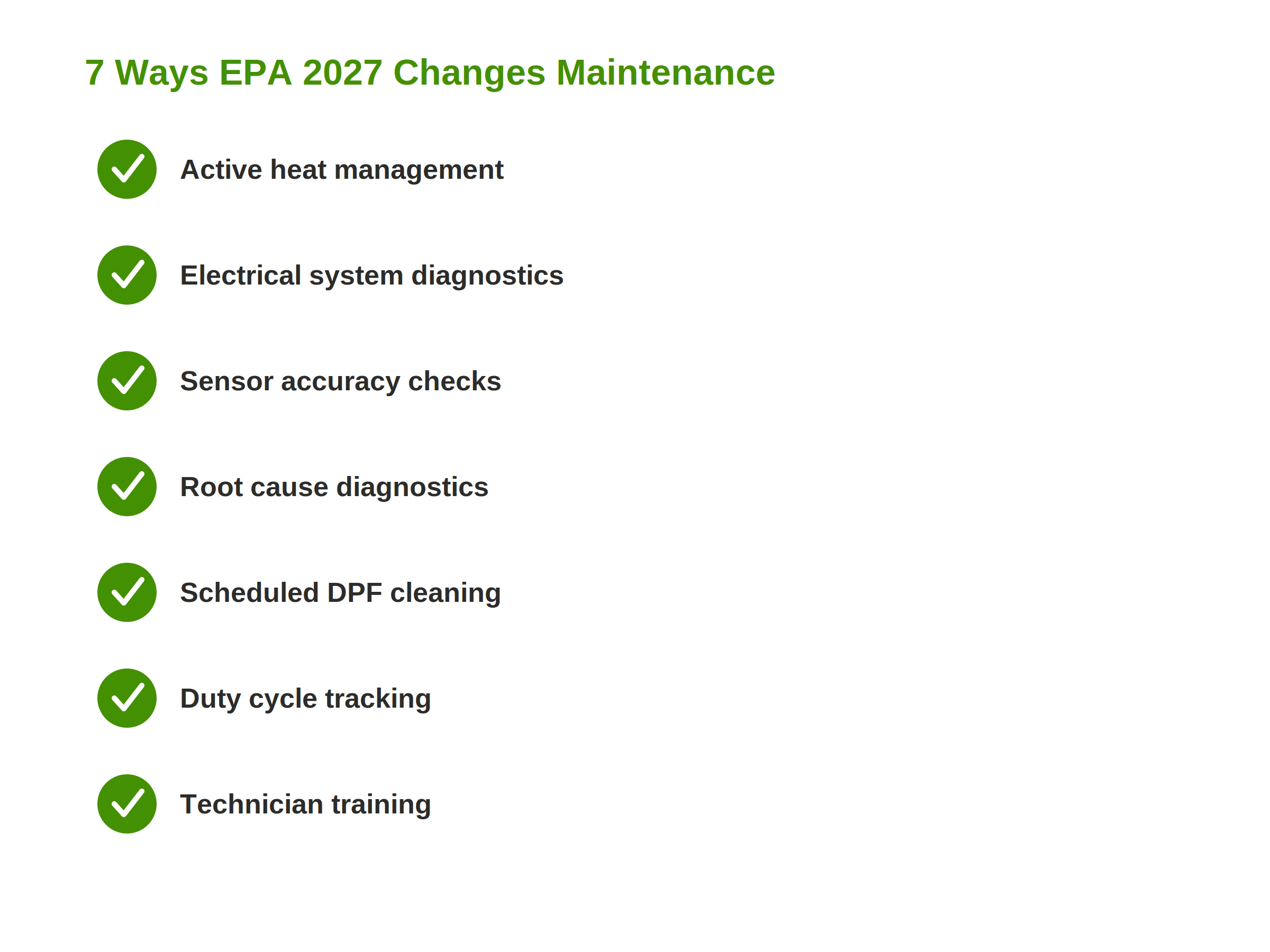
7 Ways EPA 2027 Will Change Diesel Truck Maintenance
1. Aftertreatment heat management will become more active
Previous emissions systems have depended heavily on exhaust heat created naturally by engine operation or through fuel dosing during regeneration.
EPA 2027 systems are expected to use more active methods to bring catalysts into their effective operating range.
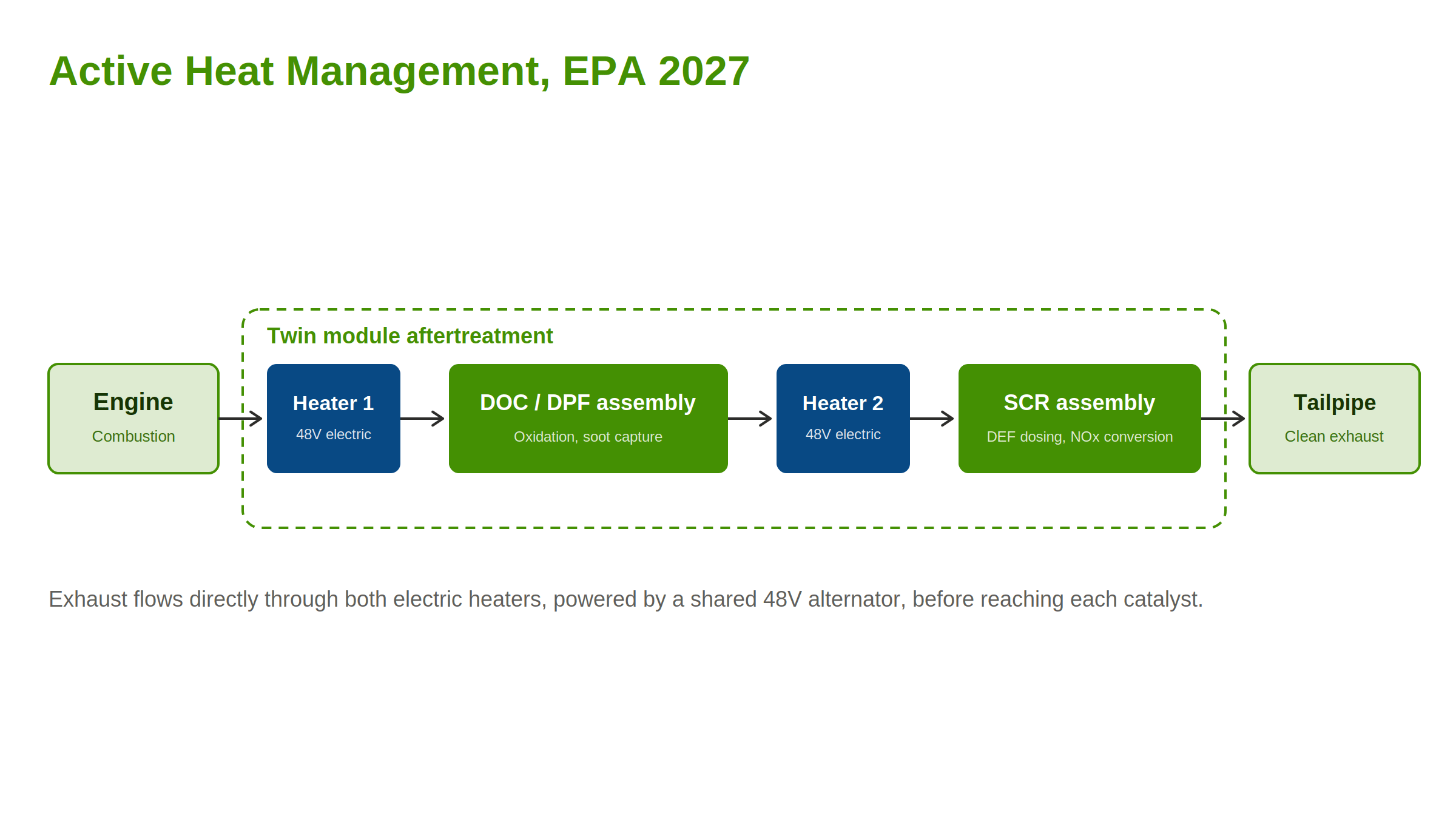
Cummins has developed a twin module aftertreatment system for its 2027 X10 and X15 diesel engines. The design uses a compact dual canister layout and a dedicated 48 volt belt driven alternator to support electrical aftertreatment heating.
Cummins describes the technology as a way to achieve rapid thermal management while supporting the lower EPA 2027 NOx limits. Electric heaters and hydrocarbon dosing can be used to maintain the exhaust temperatures needed for effective emissions reduction.
This does not mean every manufacturer will use the same design.
It does mean technicians will need to understand temperature creation and control, not merely read fault codes.
2. Electrical performance will become part of emissions diagnostics
When electrical power is used to heat the aftertreatment system, charging performance becomes part of emissions performance.
A technician diagnosing a 2027 truck may need to evaluate:
- Alternator output
- Wiring integrity
- Grounds
- Voltage stability
- Heater resistance
- Current demand
- Control module commands
- Temperature response
- Battery condition
- Network communication
That is a meaningful shift.
A truck may display an emissions related fault even though the root cause begins in the electrical system.
Technicians who treat the engine, electrical system, and aftertreatment system as separate worlds will struggle.
The truck does not recognize those departmental boundaries.
3. Sensor accuracy will matter even more
Modern emissions systems already rely on data from temperature sensors, differential pressure sensors, NOx sensors, DEF quality sensors, and other inputs.
EPA 2027 adds tighter control requirements.
The engine control system must know what is happening before the DOC, across the DPF, through the SCR system, and at the tailpipe. It must then determine whether the system is heating correctly, dosing correctly, converting NOx correctly, and remaining within its expected performance range.
A sensor does not have to fail completely to cause trouble.
A sensor that drifts, responds slowly, or reports a believable but inaccurate value can mislead the entire control strategy.
That is why a fault code should be treated as a starting point, not a parts order.
4. Root cause diagnostics will become more valuable
At DPF Guys, we regularly see filters that appear to be the primary failure but are actually the downstream result of another problem.
The DPF may be restricted, but the real cause may involve:
- Excessive soot production
- A weak or leaking injector
- Poor turbocharger performance
- An air intake restriction
- A charge air leak
- An EGR system problem
- Low engine operating temperature
- Failed regeneration attempts
- A malfunctioning DOC
- An inaccurate differential pressure sensor
- Oil or coolant contamination
- Excessive idle time
Cleaning a serviceable DPF may restore airflow.
It will not repair the condition that overloaded it, and ignoring that root cause risks the kind of backpressure damage that can wreck a turbocharger.
The more integrated the 2027 systems become, the more expensive it will be to confuse the failed component with the root cause.
5. DPF cleaning will remain necessary
EPA 2027 does not eliminate the diesel particulate filter.
A DPF traps soot produced during combustion. Regeneration burns much of that soot, but it does not remove the noncombustible ash created by engine oil additives, normal wear, and other material entering the exhaust stream.
Ash accumulates over time.
Eventually, the DPF must be removed and professionally cleaned or replaced.
This distinction matters:
Regeneration removes soot. Professional DPF cleaning removes accumulated ash and remaining contamination that regeneration cannot burn.
New control systems may improve regeneration management and reduce some forms of soot loading. They cannot turn ash into exhaust gas.
Fleets should continue tracking DPF service intervals, engine hours, mileage, oil consumption, differential pressure, and regeneration frequency.
6. Duty cycle will remain a major factor
Two identical trucks can experience completely different aftertreatment results.
A tractor operating under steady highway load may keep its exhaust system hot for hours.
A delivery truck may travel short distances, idle frequently, and shut down before the aftertreatment system completes its intended heating or regeneration process.
A vocational truck may accumulate substantial engine hours without accumulating comparable mileage.
That is why fleet maintenance cannot be based on mileage alone.
EPA 2027 systems are being designed to perform better during cold and low load conditions. That is an improvement, not permission to ignore duty cycle.
Fleet managers should examine:
- Engine hours
- Idle percentage
- Average trip length
- Average load
- Regeneration frequency
- Interrupted regenerations
- Fuel consumption
- DEF consumption
- DPF pressure
- Exhaust temperatures
- Recurring fault history
The truck’s work pattern is part of the diagnosis.
7. Technician training will become a competitive advantage
A scan tool can display data.
It cannot guarantee that the person holding it understands what the data means.
A qualified technician must be able to determine whether temperatures rise in the correct sequence, whether DPF pressure matches actual flow, whether DEF dosing is producing the expected NOx conversion, and whether an upstream engine problem is causing a downstream emissions failure.
EPA 2027 will reward technicians who understand relationships.
It will punish parts changing.
The industry will need more people who can answer questions such as:
- Is the engine producing excessive soot?
- Is the DOC creating enough heat?
- Is the DPF actually restricted?
- Is the pressure reading believable?
- Is the SCR system receiving properly prepared exhaust?
- Is DEF being dosed correctly?
- Are the NOx sensors reporting a physically reasonable result?
- Is an electrical failure preventing catalyst heating?
- Did the aftertreatment system fail, or was it overwhelmed by an engine problem?
Those are diagnostic questions, not component descriptions.
Will EPA 2027 Diesel Engines Be Less Reliable?
It is too early to know.
Manufacturers are showing systems designed to meet the new standards, but broad field reliability cannot be established before large numbers of trucks accumulate real mileage, engine hours, heat cycles, repairs, software updates, and varied operating conditions.
The Engine Technology Forum reported in May 2026 that engine and truck manufacturers appeared ready to deliver EPA 2027 compliant products. Cummins and other manufacturers have publicly presented new engines and aftertreatment systems intended for the 2027 market.
Engineering readiness is not the same as proven fleet reliability.
The real test will occur after the sale.
Reliability will depend on:
- Component durability
- Software quality
- Sensor life
- Wiring protection
- Parts availability
- Diagnostic information
- Dealer readiness
- Technician training
- Fleet maintenance
- Actual operating duty cycle
It would be irresponsible to declare the systems unreliable before they enter broad service.
It would be equally irresponsible to assume that greater complexity creates no new service risks.
Should Fleets Buy Trucks Before EPA 2027?
Some fleets may purchase additional 2026 trucks to avoid the cost and uncertainty associated with a new emissions generation.
Others may prefer 2027 trucks because of potential fuel efficiency improvements, newer powertrain designs, longer planned ownership, or confidence in the manufacturer’s support network.
There is no universal answer.
A fleet should evaluate at least seven factors:
- Replacement urgency: Can the current equipment remain productive and dependable?
- Duty cycle: Does the fleet operate in conditions that are hard on aftertreatment systems?
- Maintenance capability: Can the internal shop diagnose advanced electrical and emissions systems?
- Dealer support: Is the local dealer prepared with trained technicians, parts, and diagnostic information?
- Warranty exposure: What coverage is included, and how might current EPA proposals affect it?
- Ownership period: Will the fleet retain the truck beyond the standard emissions warranty?
- Cost of downtime: How much does an unfamiliar failure cost when a truck is loaded and committed to a customer?
Prebuying can reduce exposure to first year technology.
It can also leave a fleet operating older equipment while competitors adopt more efficient powertrains.
Waiting can provide additional field history.
It can also create shortages or unfavorable trade timing.
The right decision belongs to the fleet’s operating economics, not internet panic.
How Fleets Can Prepare for EPA 2027
Fleet preparation should begin before the first 2027 truck enters the yard.
Establish a performance baseline
Document normal fuel use, DEF use, idle time, regeneration frequency, exhaust temperatures, DPF pressure, oil consumption, fault history, and service intervals.
You cannot recognize deterioration if normal performance was never recorded.
Track engine hours as well as mileage
Low mileage does not necessarily mean low use.
A truck can accumulate considerable engine wear, ash, and aftertreatment exposure while sitting still.
Investigate repeat faults early
A fault that disappears is not necessarily a fault that repaired itself.
Repeated emissions codes, unsuccessful regenerations, abnormal DEF consumption, and changing temperature patterns often provide warning before a severe derate.
Test before replacing
Confirm component failure through data, inspection, electrical testing, flow testing, or other appropriate methods.
A fault code is evidence. It is not a verdict.
Control oil consumption
Oil consumption contributes to DPF ash accumulation and may indicate engine wear or other mechanical problems.
An aftertreatment system cannot correct an engine that is feeding it contamination.
Reduce avoidable idling
The next generation of systems may manage low temperature conditions better, but unnecessary idling still consumes fuel, accumulates engine hours, and creates difficult operating conditions.
Build service relationships now
Identify the dealers, independent shops, mobile technicians, and aftertreatment specialists capable of supporting the fleet.
Do not begin interviewing repair partners after a loaded truck starts a derate countdown.
What EPA 2027 Does Not Change
The technology is changing. The basic maintenance truth is not.
A diesel engine still requires:
- Proper airflow
- Correct fuel delivery
- Adequate compression
- Proper lubrication
- Accurate sensors
- Working temperature controls
- Correct DEF
- A functioning DOC
- A serviceable DPF
- Effective SCR conversion
- Competent diagnostics
The aftertreatment system remains downstream from the engine.
When the engine produces excessive soot, consumes oil, leaks coolant, operates too cold, or receives inaccurate sensor data, the emissions system eventually pays the bill.
EPA 2027 may improve how the truck identifies and manages those conditions.
It will not repeal cause and effect.
Frequently Asked Questions About EPA 2027 Diesel Engines
When do the EPA 2027 diesel engine requirements begin?
The standards apply beginning with model year 2027 heavy duty engines and vehicles covered by the rule. EPA adopted the original final rule in December 2022.
What is the EPA 2027 NOx limit?
The primary model year 2027 NOx standard is 0.035 grams per brake horsepower hour, compared with the previous 0.20 standard. This represents a reduction of more than 80 percent in the applicable limit.
Will EPA 2027 affect trucks already on the road?
The new engine certification standards primarily apply to new engines beginning with model year 2027. They do not automatically require an existing truck to be converted into a 2027 emissions configuration.
Existing trucks must still comply with the emissions laws, inspection requirements, and anti tampering rules that apply to them.
Will 2027 diesel engines still have DPF systems?
Yes. Diesel particulate filters remain an essential part of controlling particulate matter from diesel exhaust.
Will DPF cleaning still be required?
Yes. Regeneration burns combustible soot, but it does not remove accumulated ash. A serviceable DPF will still require professional cleaning when ash or other contamination creates excessive restriction.
Will EPA 2027 engines use 48 volt systems?
Some will. Cummins has announced a dedicated 48 volt belt driven alternator for its EPA27 X10 and X15 platforms to support electrical heating within its twin module aftertreatment system. Other manufacturers may use different designs.
Why do the new systems need electrical heaters?
SCR catalysts require sufficient temperature to reduce NOx effectively. Electrical heating can bring the system into its effective operating range faster during cold starts and low load operation.
Will EPA 2027 trucks use more DEF?
Actual DEF consumption will depend on engine design, calibration, duty cycle, load, operating temperature, and manufacturer strategy. Fleets should not assume one universal percentage increase or decrease without vehicle specific data.
Will the new standards improve fuel economy?
Emissions compliance and fuel economy are separate performance measures, although manufacturers are developing the engine, transmission, combustion system, and aftertreatment system together.
Some manufacturers are claiming fuel efficiency improvements for specific new products. Actual fleet results will depend on configuration, application, driver behavior, load, terrain, and duty cycle.
Are the EPA 2027 regulations final?
The original heavy duty engine rule was finalized in 2022. However, EPA proposed additional amendments on July 14, 2026, involving warranty periods, useful life provisions, testing procedures, nonconformance penalties, and other compliance details.
Those proposed amendments were not final when this article was published.
Should fleets avoid buying 2027 diesel trucks?
Not necessarily.
Fleets should evaluate the equipment based on their replacement needs, maintenance capabilities, duty cycle, dealer support, warranty coverage, operating costs, and tolerance for new technology risk.
Fear is not a fleet strategy.
Neither is blind optimism.
The Cleanest Diesel Engine Still Needs a Competent Owner
EPA 2027 represents a major change in diesel emissions control.
The engines are expected to produce substantially less NOx across a broader range of operating conditions. Manufacturers are responding with active heat management, electrical aftertreatment heating, revised combustion systems, more advanced sensors, and tighter powertrain integration.
Those improvements may deliver cleaner exhaust and better overall performance.
They will also make correct diagnosis more important.
A cleaner engine is not a maintenance free engine.
A smarter aftertreatment system is not a self repairing aftertreatment system.
A fault code is still not a root cause.
The fleets that perform best with EPA 2027 equipment will not necessarily be the fleets with the newest trucks.
They will be the fleets that understand their data, maintain the engine before it damages the aftertreatment system, train their technicians, investigate recurring faults, and build relationships with qualified repair partners before an emergency.
The technology is changing.
The obligation to maintain it correctly is not.
How DPF Guys Helps Protect Fleet Uptime
DPF Guys works with fleets, repair shops, and owner operators to inspect, test, clean, and evaluate diesel aftertreatment components.
Our services include professional DPF, DOC, and SCR cleaning, flow and weight testing, aftertreatment diagnostics, replacement components, and assistance identifying whether a restricted filter is the actual failure or the result of an upstream problem.
Our objective is not merely to clean a filter.
It is to help put the truck back to work faster and keep it operating longer while remaining compliant.
Contact DPF Guys before a repeated emissions fault becomes a roadside derate.