
Profit to Pollute: What the Diesel Delete Pardon Story Leaves Out
The federal government has pardoned diesel mechanics and companies, stopped pursuing certain criminal emissions cases, and expanded access to emissions repair information. None of those actions turned permanent emissions defeat into lawful repair.
That distinction matters because the diesel pardon story keeps combining three separate questions:
- Should truck owners and independent shops have the tools needed to repair emissions systems?
- Was prison an excessive punishment in some tampering cases?
- Should companies be allowed to manufacture and sell emissions defeat devices as a national business?
The first two questions deserve a serious debate. They do not answer the third.
Court records show that some of the largest federal cases were not about a farmer fixing one tractor or an owner operator trying to move one load. They involved organized businesses, commercial products, national distribution, manufacturing, marketing, and revenue measured in tens of millions of dollars.
That is the part of the story described here as Profit to Pollute.
What Changed in the Diesel Delete Debate?
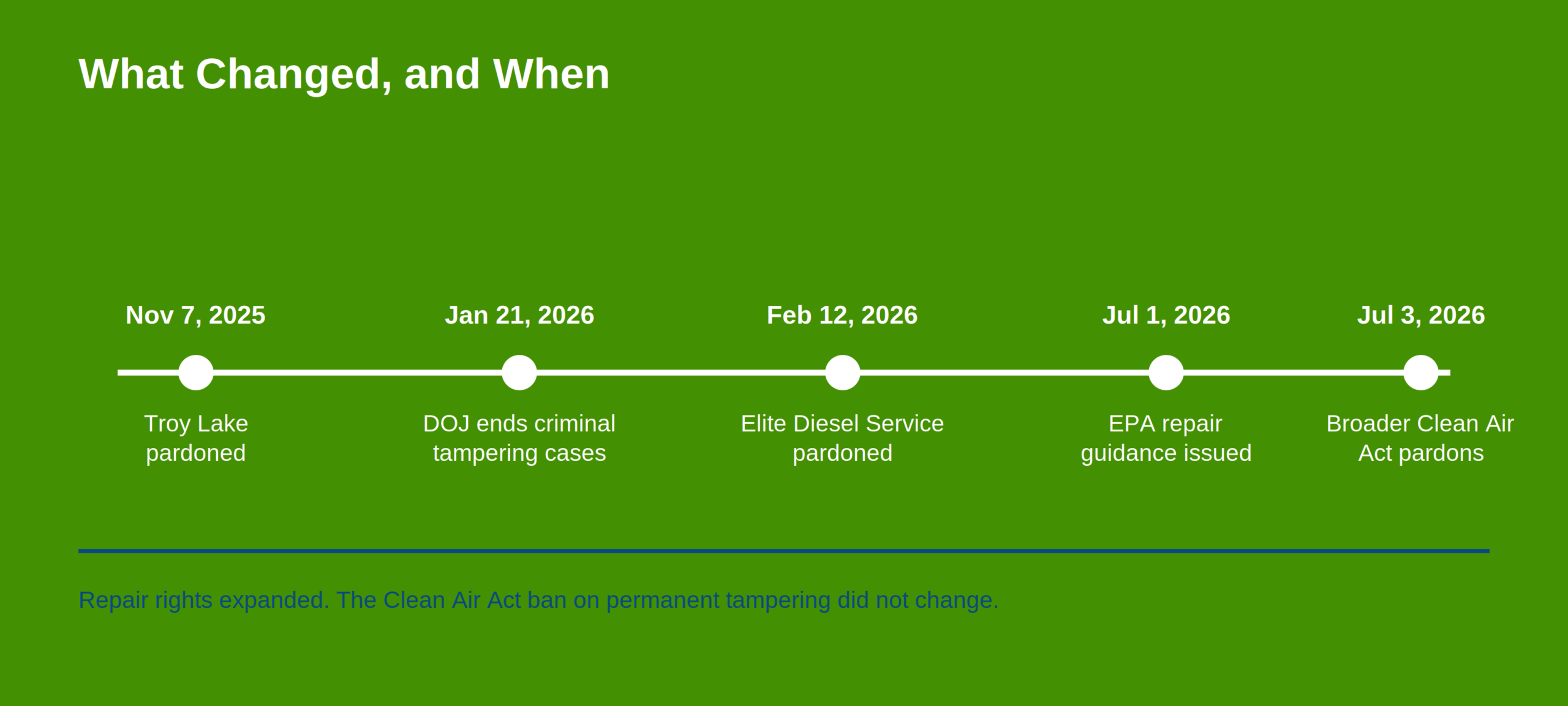
President Donald Trump pardoned Elite Diesel Service owner Troy Lake on November 7, 2025. The Department of Justice announced on January 21, 2026 that it would no longer pursue criminal charges based on allegations of tampering with vehicle onboard diagnostic devices, while stating that civil enforcement could continue when appropriate. Elite Diesel Service itself received a pardon on February 12, 2026.
The policy shift continued during the summer.
On July 1, 2026, the EPA issued new guidance supporting access to emissions repair information, tools, training, equivalent replacement parts, and temporary overrides when they are genuinely required to restore proper operation. The agency also recognized the SEMA Certified Emissions program as another way for aftermarket parts manufacturers to demonstrate federal compliance.
On July 3, the President issued another group of pardons that included numerous individuals and companies convicted in Clean Air Act cases involving vehicle emissions controls.
These changes are significant. They affect enforcement priorities, criminal exposure, access to repair resources, and the treatment of prior convictions.
They do not erase the Clean Air Act prohibition against permanent tampering. The EPA stated directly in its July guidance that the new actions did not change the law, weaken emissions standards, or reduce compliance obligations. It also stated that aftermarket parts cannot bypass, tamper with, or remove vehicle emissions controls.
The right to repair is broader now.
The right to delete is not.
Three Different Arguments Are Being Treated as One
Most of the confusion disappears when the debate is separated into its proper parts.
1. The Right to Repair
Truck owners should be able to obtain the information, tools, software access, training, and equivalent parts necessary to diagnose and repair equipment.
That is especially important when a broken DEF or aftertreatment component can sideline a working truck far from a dealership.
The EPA’s July 2026 guidance recognizes that problem. Manufacturers must make repair information and tools available on reasonable terms, including information related to DEF and other environmental control systems. The guidance also recognizes temporary overrides when their purpose is to restore proper operation.
That is repair.
2. Proportional Punishment
It is reasonable to question whether prison is the proper response in every emissions tampering case.
A first offense by a small operator is not the same as a national manufacturing or smuggling operation. Criminal punishment can be disproportionate even when the underlying conduct violated the law.
The Justice Department cited efficient use of government resources and the avoidance of excessive criminalization when it announced its new enforcement position in January 2026.
That is an argument about punishment.
3. Commercial Defeat Device Sales
A company that manufactures, markets, imports, or sells thousands of products designed to disable emissions controls is not merely exercising a repair right.
Its product has a commercial purpose. The customer pays because the product bypasses or defeats a required system.
That is an argument about a business model.
Combining all three questions under the word “freedom” protects the weakest conduct with the strongest argument.
The Sympathetic Case Was Still a Commercial Network
Troy Lake became the public face of the pardon campaign. He was often described as a diesel mechanic imprisoned for helping truck owners fix equipment that no longer operated properly.
There is a legitimate fairness argument in his case. A twelve month prison sentence can be questioned without pretending the conduct never happened.
The official record, however, does not describe one mechanic working on one neighbor’s truck.
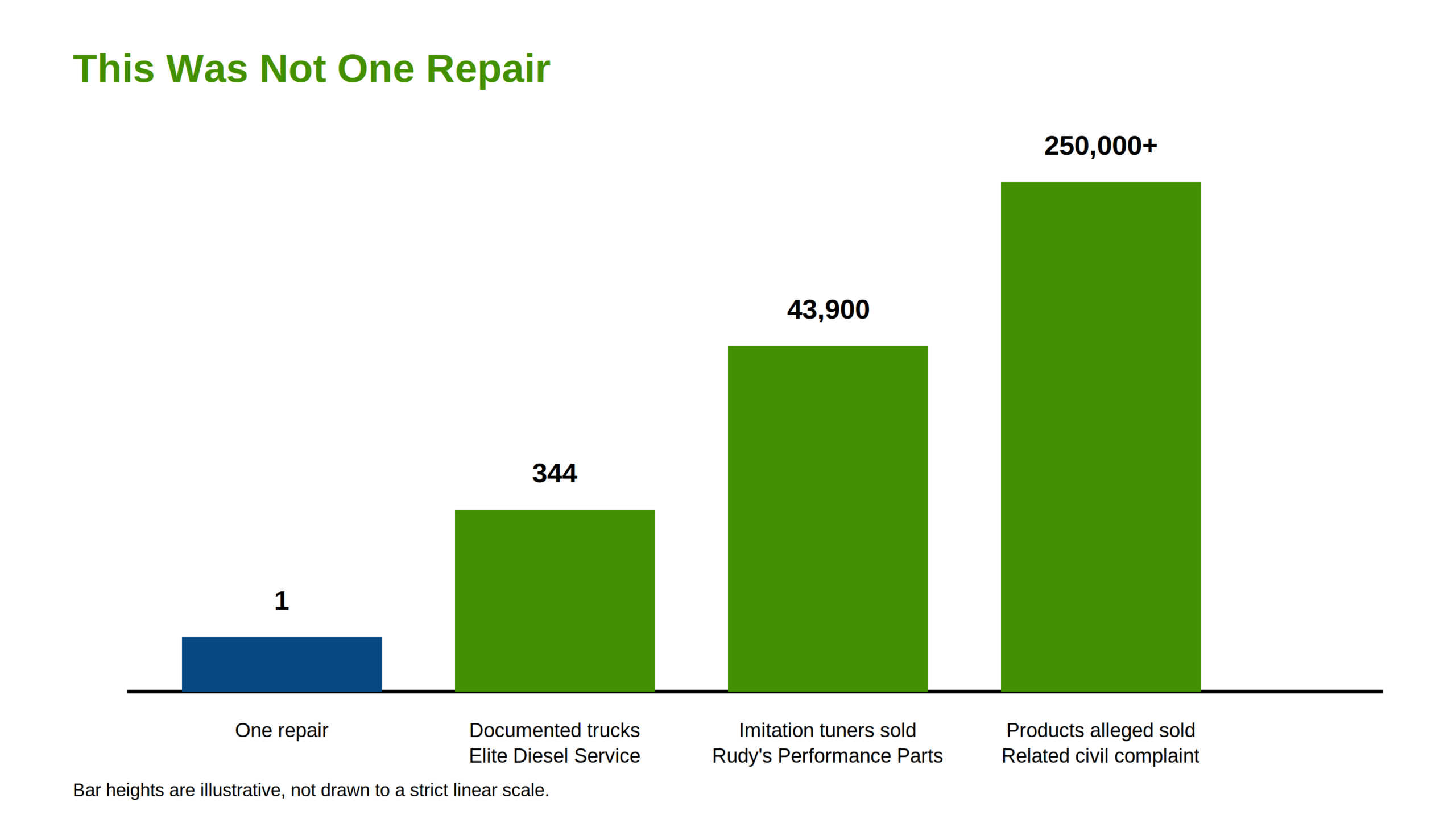
Elite Diesel Service and Lake pleaded guilty to conspiring to violate the Clean Air Act by disabling monitoring components on at least 344 heavy duty commercial trucks. Eight other participants located across seven states had already been sentenced for their roles. Other diesel garages and fleets removed the physical emissions components, then sent the trucks to Elite to alter the onboard diagnostic systems so the computers would not detect the missing or disabled hardware.
The words “at least 344” matter. That figure was the documented minimum contained in the plea agreement. It was not presented as a maximum.
Lake’s wife also told Cowboy State Daily that the business had spent approximately $350,000 on research and development, including $325,000 for an emissions test bench. She said the company had invested more than $1 million in engine and chassis dynamometers used for several areas of the business, not only emissions modifications. Her distinction should be preserved, but the scale still describes a serious commercial operation rather than an informal backyard repair.
None of this proves that every customer arrived with bad intentions. It does not prove that imprisonment was necessary. It does not turn Lake into a cartoon villain.
It proves something narrower and more useful: even the most sympathetic case involved an established business, specialized equipment, hundreds of documented trucks, referrals from other shops, and participants operating across several states.
That fact should not disappear behind a picture of one mechanic with a wrench.
Follow the Money
The clearest difference between ordinary repair work and the defeat device industry appears in the revenue.
Rudy’s Performance Parts
Rudy’s Performance Parts manufactured and sold emissions defeat devices, including imitation delete tuners that altered onboard diagnostic systems.
According to EPA and Justice Department records, the company sold approximately 43,900 imitation tuners between 2015 and 2018, generating approximately $33 million in revenue. A related civil complaint alleged that Rudy’s and its owner manufactured and sold more than 250,000 products designed to remove or disable required emissions controls from at least 2014 through the middle of 2019.
The operation included internal manufacturing. Rudy’s purchased an $850,000 laptop containing software used to convert tuners into imitation versions of another company’s products. The combined criminal and civil resolution totaled approximately $10 million.
The EPA estimated that the products described in the civil case produced pollution equivalent to adding more than one million vehicles to American roads.
That is not a mechanic reluctantly completing one questionable job.
That is product development, manufacturing, sales volume, and substantial commercial revenue.
DPF Delete Shop
A separate federal indictment alleged that businesses operated by John and Joshua Owens purchased more than $33 million in emissions defeat devices from Canadian suppliers and generated more than $74 million through online sales to American customers between 2017 and 2023.
The indictment also alleged disguised international shipments, smuggling, money laundering, the creation of a new business named DPF Delete Shop after EPA inquiries, and the use of a Cayman Islands business address.
Those allegations require an important qualification.
The case did not end in convictions. After the Justice Department changed its criminal enforcement position, the government moved to dismiss the indictment without prejudice on February 13, 2026. The allegations were therefore never resolved through a completed trial.
The case should not be presented as proven criminal conduct.
It remains relevant for a more limited reason: the federal investigation documented the size and commercial organization that prosecutors believed existed within parts of the defeat device market. Even as an allegation, $74 million in reported online revenue bears little resemblance to the public image of a neighbor helping repair a tractor.
Precision matters. So does scale.
What “Profit to Pollute” Actually Means
Profit to Pollute is not a label for every mechanic who made a bad decision.
It is not a claim that every person who questioned an emissions regulation was dishonest.
It is not an argument that an emissions system never fails or that every regulation is perfectly written.
It describes a specific commercial arrangement:
- A product is designed or sold because it disables required emissions controls.
- The seller’s revenue increases as more of those products are manufactured and sold.
- The pollution increase is not an accidental side effect of an unrelated product. Defeating the emissions system is the function being purchased.
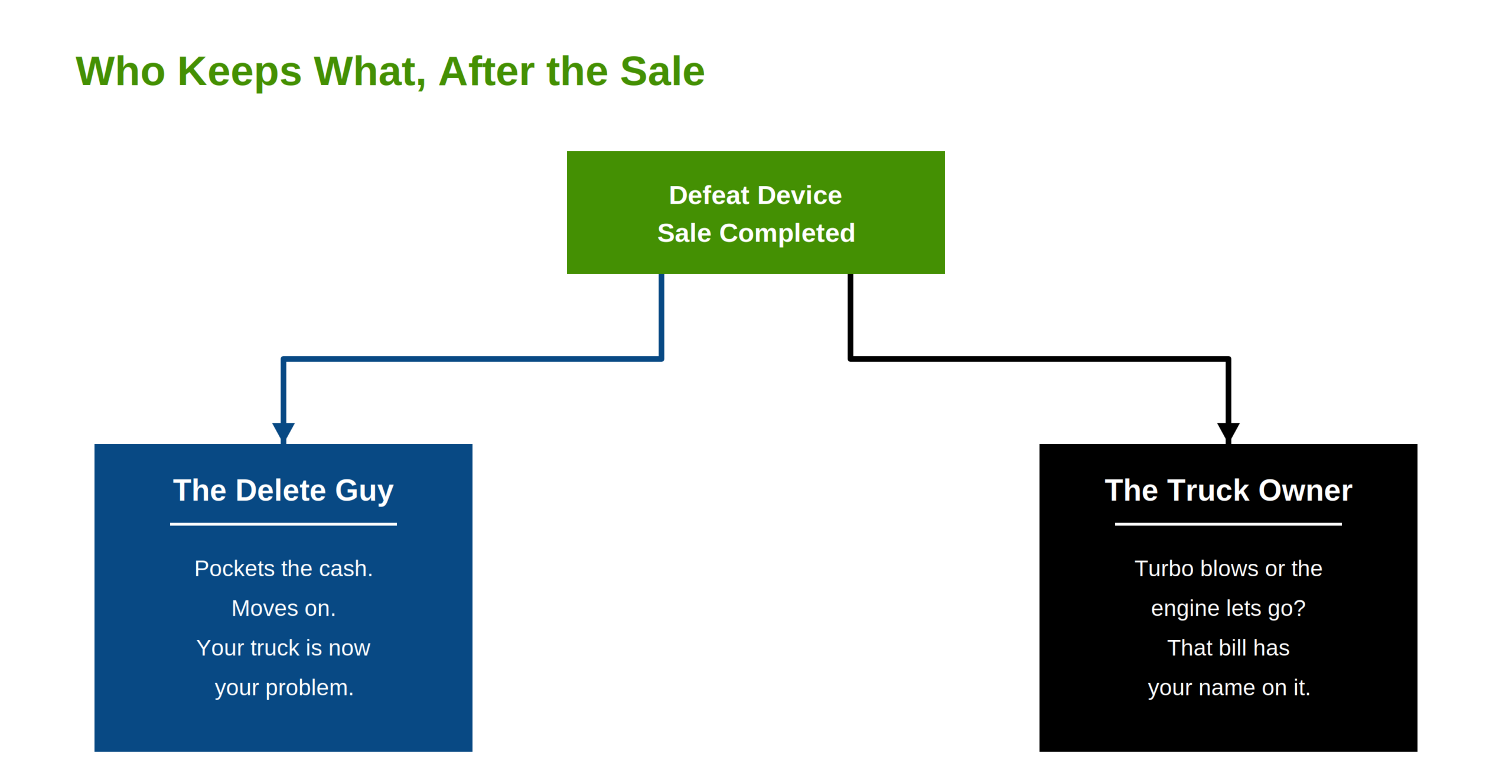
- The customer retains the modified truck and whatever consequences follow.
- The seller recognizes the revenue when the sale is completed.
A repair business earns money by restoring equipment to proper operation.
A defeat device business earns money by helping equipment operate outside its certified emissions configuration.
That is the line.
Repair restores.
Defeat disables.
Right to Repair Is Not Right to Delete
The strongest argument against excessive emissions regulation is the right to repair.
It is also the argument most easily misused.
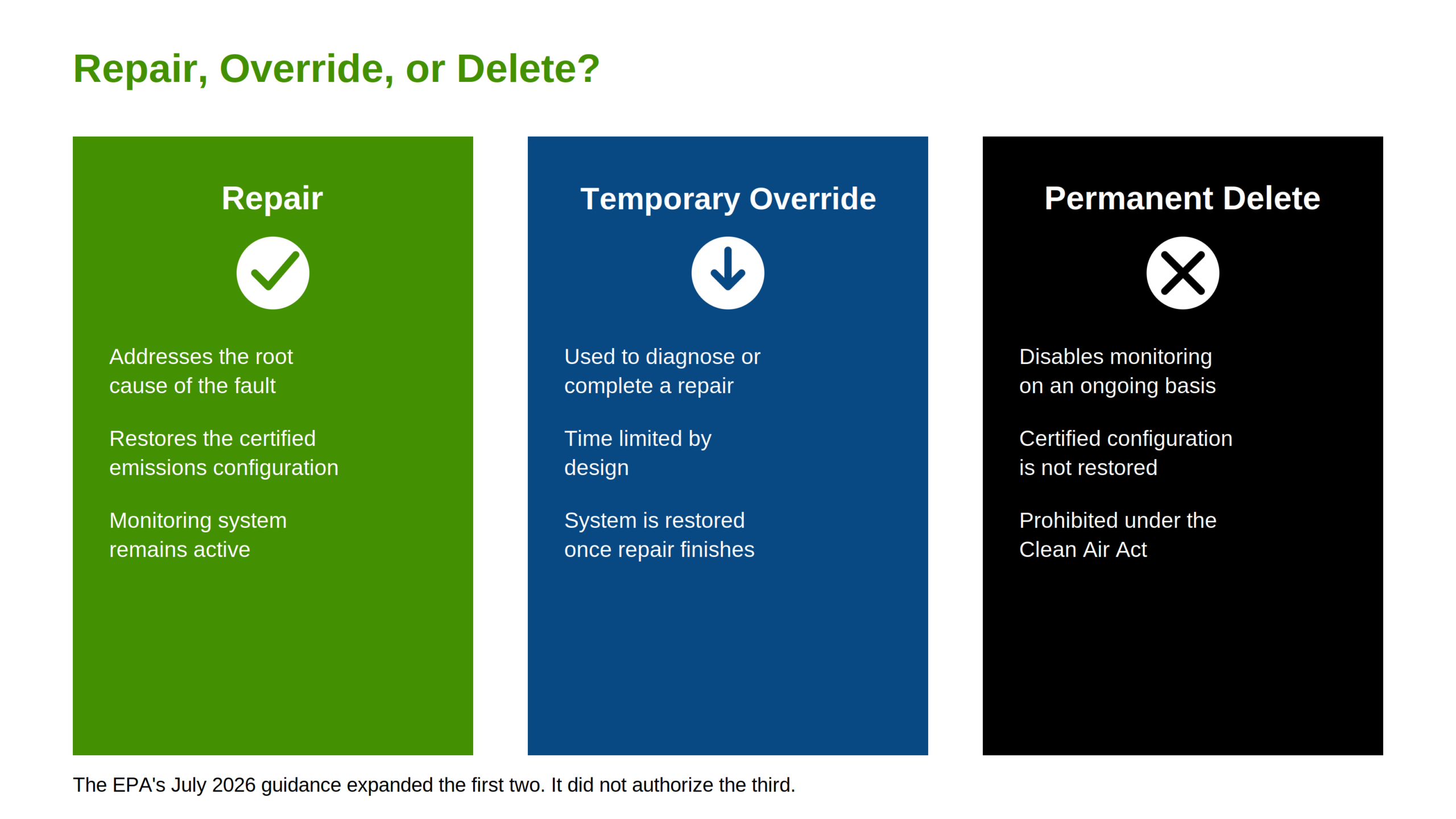
The EPA’s July 2026 guidance gives independent shops and owners greater access to service information, diagnostic tools, training, equivalent parts, and temporary overrides used for legitimate repairs. It does not authorize the permanent removal or defeat of the system.
The difference is purpose and outcome.
A legitimate repair may temporarily interrupt a system while the technician diagnoses a fault or restores proper operation.
A delete permanently alters the truck so the emissions hardware or monitoring system no longer performs the function required under its certified configuration.
The new SEMA certification path reinforces the same distinction. Aftermarket innovation is permitted, but the manufacturer must demonstrate that the equipped vehicle can still pass the emissions testing used for its original certification. The EPA expressly stated that aftermarket parts cannot bypass, tamper with, or remove emissions controls.
Repair freedom and emissions compliance are therefore not opposites.
The updated policy is attempting to protect both.
The Mechanical Argument Should Not Be Exaggerated
There is no need to claim that every deleted truck immediately runs worse.
Some operators delete emissions systems because they believe doing so reduces maintenance costs, avoids certain component failures, simplifies the truck, or improves fuel economy. A properly executed tune may suppress the fault codes and derates that would otherwise occur when emissions hardware is removed.
Pretending otherwise weakens the case for compliance. People who work on these trucks know better.
The stronger argument is economic and operational.
A delete does not eliminate risk. It exchanges one set of costs for another. The operator may avoid certain aftertreatment repairs, but the truck is no longer operating in its certified emissions configuration. The owner retains the modified asset, must eventually decide whether to restore it, and may face a smaller group of willing buyers or service providers.
The person selling the delete does not remain responsible for the truck forever.
The truck owner does.
That asymmetry should be part of the buying decision.
Compliance Costs Money, but Cost Is Not the Whole Test
Emissions systems cost money to maintain.
So do brakes, commercial insurance, driver qualification programs, safety inspections, workers’ compensation, drug testing, electronic logging systems, and other requirements attached to commercial operation.
The existence of a cost does not prove that a requirement has no public purpose.
It does not prove the requirement is well designed either.
The proper questions are:
- What harm is the rule intended to prevent?
- Does the requirement reduce that harm?
- Is the cost proportionate to the benefit?
- Can the same result be achieved with less downtime or expense?
- Are owners receiving the repair access and technical support needed to comply?
- Is enforcement focused on deliberate commercial abuse or indiscriminate punishment?
Those questions can produce better regulations.
“Rules cost money” cannot settle the debate by itself.
Fairness Cuts in Both Directions
The strongest defense of the pardon recipients is straightforward.
Some were small business owners. Some may have believed they were solving a mechanical problem rather than committing an environmental crime. Some sentences may have been greater than necessary. The federal government may have relied too heavily on criminal prosecution when civil enforcement, compliance agreements, or restitution would have been enough.
Those arguments deserve a direct response.
But fairness also applies to the companies that remained compliant.
Fleets and owner operators spend real money diagnosing faults, cleaning DPFs, replacing failed sensors, repairing wiring, restoring damaged aftertreatment systems, and returning trucks to their certified configurations.
A competing operator that deletes equipment may avoid some of those costs. A company selling the delete then earns revenue by helping create that difference.
Whether someone supports the current law or wants Congress to change it, that competitive imbalance is real.
The honest debate is therefore not:
Hardworking mechanic or heartless regulator?
It is:
What repair rights should owners have, what punishment is proportionate, and where should the law draw the line around businesses selling permanent noncompliance?
Those are harder questions.
They are also the real ones.
Ten Signs a Case Was About Commercial Enterprise, Not One Repair
-
The activity involved an incorporated business. The work was performed under a company name with organized operations.
-
The company manufactured or converted products. Building tuners or delete components is different from repairing one customer’s truck.
-
Sales occurred at significant volume. Tens of thousands of units indicate a product business.
-
Revenue reached millions of dollars. Large revenue figures show that emissions defeat was commercially important.
-
Products were marketed nationally. Websites, online marketplaces, and dealer networks extend far beyond local repair work.
-
The business used suppliers and distribution channels. Organized sourcing and fulfillment are signs of an established market.
-
The product was promoted for its ability to disable emissions controls. The prohibited function was part of the offer.
-
Other shops referred work into the operation. A multistate referral network is different from an isolated favor.
-
The business took steps to continue after regulatory warnings. Entity changes, concealed shipments, or relocated addresses may show that the conduct was deliberate, although such allegations must be proved in each case.
-
The environmental effect increased with sales volume. Every additional unit extended the same emissions defeat to another vehicle.
None of these factors alone decides whether prison is justified.
Together, they show why the commercial cases cannot honestly be reduced to one farmer repairing one machine.
Questions Truck Owners Should Ask Before Authorizing Emissions Work
Is the shop repairing the system or disabling it?
The invoice should make that clear.
What caused the original fault?
A failed DPF is sometimes the result of an upstream engine, fuel, air, EGR, sensor, wiring, or operating problem. Replacing or cleaning the filter without finding the cause may only restart the clock.
Will the truck return to its certified configuration?
A completed repair should restore the monitoring system and emissions hardware to proper operation.
Is the replacement part compliant?
The EPA now recognizes additional certification pathways for aftermarket emissions parts, but the part must still meet federal requirements.
Can the shop document the diagnosis and completed work?
Documentation protects the owner, the shop, and the next technician who works on the truck.
What risks remain after the repair?
A credible shop should explain what was corrected, what was tested, what remains uncertain, and what operating condition could cause the problem to return.
Is the recommended work solving the cause or hiding the symptom?
A tune that prevents the computer from reporting a fault does not necessarily correct the condition that caused the fault.
Frequently Asked Questions
Are diesel deletes legal now?
No. The EPA stated on July 1, 2026 that its new repair guidance did not change the law or reduce compliance obligations. It also stated that aftermarket parts cannot bypass, tamper with, or remove emissions controls.
Did the presidential pardons repeal the Clean Air Act?
No. A pardon applies to the named recipient and the covered federal offense. It does not repeal the statute or automatically legalize the same conduct for other people.
What did the Justice Department change?
The Justice Department announced that it would stop pursuing criminal charges based on allegations of tampering with vehicle onboard diagnostic devices. It said civil enforcement could still be pursued with the EPA when appropriate.
Does the right to repair allow a temporary emissions override?
The EPA says a temporary override can be permitted when it is used for the purpose of repair and restoring proper functionality. That is different from permanently programming the vehicle to operate without required emissions controls.
What was Troy Lake convicted of?
Lake pleaded guilty to conspiring to violate the Clean Air Act by disabling onboard diagnostic monitoring on at least 344 heavy duty commercial trucks. The case involved eight previously sentenced participants across seven states. He was pardoned on November 7, 2025.
Was Elite Diesel Service also pardoned?
Yes. The company received a presidential pardon on February 12, 2026.
Was DPF Delete Shop convicted of the $74 million scheme?
No. A federal indictment alleged more than $74 million in online defeat device sales, along with smuggling and money laundering. The government moved to dismiss the indictment without prejudice in February 2026 after the Justice Department changed its enforcement position. The allegations were not resolved through a completed trial.
How much revenue did Rudy’s Performance Parts generate?
Federal records state that Rudy’s sold approximately 43,900 imitation delete tuners and generated approximately $33 million in revenue. A separate civil complaint alleged sales of more than 250,000 emissions defeat products.
Does this mean every mechanic who performed a delete was running a major criminal enterprise?
No. Scale, intent, organization, prior warnings, sales volume, and commercial conduct differ from case to case. Questioning excessive punishment does not require pretending that large commercial operations were isolated repairs.
What is the difference between repair and delete work?
Repair restores the emissions system and its monitoring functions. A delete disables, bypasses, removes, or conceals those functions so the vehicle can continue operating outside its certified configuration.
The Bottom Line
The diesel emissions story should not be reduced to heroes and villains.
Truck owners deserve affordable repairs, access to diagnostic information, reasonable parts choices, and relief from systems that can immobilize working equipment without an immediate repair option.
The government should also distinguish between a small first offense and an organized commercial enterprise. Criminal punishment should be proportionate.
But those positions do not require rewriting the record.
Some companies manufactured, marketed, imported, and sold products whose commercial purpose was to disable required emissions controls. One resolved case generated approximately $33 million in tuner revenue. Another dismissed prosecution alleged more than $74 million in online sales.
That is not merely repair.
It is a market.
When the defeat of pollution controls becomes the product, and sales volume determines the revenue, the proper description is Profit to Pollute.
The repair debate is legitimate.
The punishment debate is legitimate.
Commercializing permanent noncompliance is a different question, and it should be judged on its own facts.
Repair restores the truck. Profit to Pollute sells the defeat.
DPF Guys provides diesel particulate filter cleaning, aftertreatment diagnostics, emissions system repair, and compliance focused service for fleets, owner operators, and diesel repair shops in the Atlanta area.
DPF Guys
636 Cordell Drive, Suite B
Atlanta, Georgia 30349
404-999-1361
www.dpfguys.com
info@dpfguys.com
Source Note
This article was inspired by recent reporting and public debate surrounding diesel emissions pardons and federal enforcement changes.
Principal sources include the Department of Justice Office of the Pardon Attorney, the EPA’s July 2026 Freedom to Fix guidance, EPA and Justice Department records concerning Rudy’s Performance Parts, the District of Colorado sentencing record for Elite Diesel Service and Troy Lake, the Eastern District of Washington indictment involving DPF Delete Shop, and the government’s February 2026 motion to dismiss that case.