
Your Truck Is Already Broke. You Just Don’t Know It Yet.

Why Every Mile Should Pay for the Next One, and How to Calculate the Right Maintenance Reserve for How You Truck
Most owner-operators think truck repairs begin the day something breaks.
- A turbocharger fails.
- A transmission starts slipping.
- The engine derates.
- The DPF plugs.
- A dashboard lights up like a Christmas tree.
Those are the same classic warning signs of a truck heading toward derate, showing up right before the bigger bill arrives.
That’s when the repair starts. At least, that’s what it feels like.
In reality, the repair began months, sometimes years, earlier. It began one mile at a time.
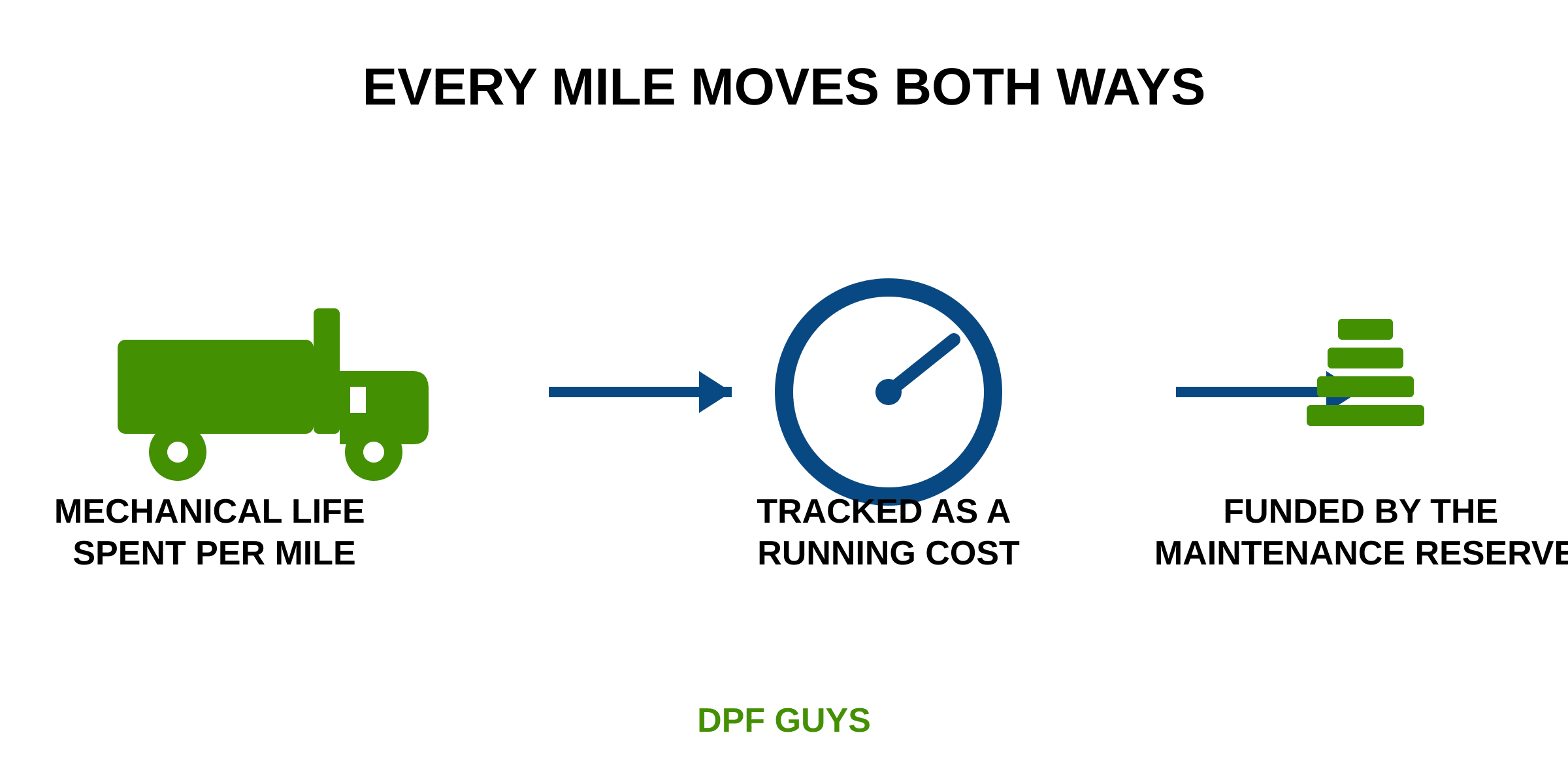
Every commercial truck is constantly exchanging mechanical life for revenue.
- Every load hauled.
- Every stop made.
- Every hour spent idling.
- Every mountain climbed.
- Every regeneration completed.
- Every cold start on a winter morning.
- Every minute powering a PTO.
Every mile consumes a tiny portion of the truck’s future. That’s not a defect. It’s exactly what the truck was built to do.
Commercial trucks are not static assets. They are machines designed to convert their own mechanical life into productive work. Every component has a finite service life, and every hour of operation moves it closer to replacement. That is the fundamental economics of trucking.
The mistake many trucking businesses make is believing the cost of ownership appears only when an invoice arrives. It doesn’t. The cost has been accumulating all along. The invoice is simply the day you finally receive the bill.
That single shift in thinking changes everything.
Instead of asking,
“How much is this repair going to cost me?”
A better question becomes,
“Has this truck been earning enough every mile to pay for the life it has already consumed?”
Successful fleets have been asking versions of that question for decades. They understand something many smaller operators never fully embrace.
Repairs are not random financial emergencies. They’re operating expenses with uncertain timing.
No fleet manager expects wheel bearings, injectors, turbochargers, DPFs, batteries, belts, air compressors, sensors, or transmissions to last forever. The exact day of replacement may be unknown. The replacement itself is not.
That distinction is one of the biggest differences between managing a truck and managing a trucking business.
Professional fleets don’t wait until a component fails before thinking about how to pay for it, and a structured preventive maintenance program is where that thinking starts. They build maintenance reserves into the cost of operating every vehicle.
Each mile contributes a small amount toward future maintenance. Each month, the business prepares for repairs that haven’t happened yet because experience says they eventually will.
Owner-operators often don’t have that luxury, which is part of why so many owner-operators struggle to get ahead financially even when freight is steady. When you’re running one truck, every dollar has another job.
- Fuel.
- Insurance.
- Truck payments.
- Taxes.
- Permits.
- Payroll.
- Mortgage.
- Family.
It becomes very easy to believe that whatever remains in the checking account belongs to you. Unfortunately, some of that money already belongs to the truck. It just hasn’t asked for it yet.
That’s the idea behind a maintenance reserve. Not an emergency fund. Not a rainy-day account.
A maintenance reserve is money intentionally set aside because you know your truck is consuming itself every time it goes to work. It acknowledges a simple truth.
The truck isn’t getting older while it’s parked. It’s getting older while it’s earning. And every mile should help pay for the next one.
This article isn’t about predicting the next repair. Nobody can do that. It’s about building a financial system that prepares your business long before the repair order is written.
Because the strongest trucking businesses aren’t the ones that never experience breakdowns. They’re the ones that are financially prepared when they do.
Before we talk about how much to save, we need to rethink one of the biggest myths in trucking: the idea that repairs are unexpected.
Every Mile Should Pay for the Next One
If you’ve read this far, you’ve probably realized this article wasn’t really about maintenance reserves. It was about changing the way we think about commercial trucks.
Every truck is wearing out. Right now. Not because something is wrong with it. Because that’s exactly what it was designed to do.
A commercial truck converts mechanical life into productive work.
- Every load hauled.
- Every stop made.
- Every regeneration completed.
- Every hour spent idling.
- Every mile traveled.
The truck is exchanging a small amount of its future for revenue today. That’s not failure. That’s business.
The businesses that understand this don’t fear maintenance. They plan for it.
They don’t view repairs as unfortunate surprises. They view them as predictable operating expenses with uncertain timing.
That single mindset changes everything. Instead of reacting to repairs, they prepare for them. Instead of hoping nothing breaks, they build businesses that can absorb the inevitable.
Instead of asking,
“How much did this repair cost?”
They ask,
“Did this truck earn enough to pay for the life it consumed?”
That’s a much better question.
Because every trucking business, whether it operates one truck or one thousand, is managing the same equation. Mechanical life goes out. Revenue comes in. The only question is whether enough of that revenue stays behind to replace the life that was consumed.
When it does:
- Repairs become manageable.
- Cash flow becomes more predictable.
- Downtime becomes less disruptive.
- Customers gain confidence.
- Businesses become stronger.
- And owners sleep better.
That’s what maintenance reserves really provide. Not money. Confidence.
The confidence to authorize the right repair, whether that means deciding between cleaning and replacing a DPF or something else entirely. The confidence to protect uptime. The confidence to make decisions based on what’s best for the business instead of what’s left in the checking account.
Professional fleets have operated this way for decades because they understand lifecycle economics, total cost of ownership, and the financial value of uptime. Those same principles apply whether a business operates one truck or thousands, and they hold up even as parts and labor costs shift industry-wide.
There is no reason owner-operators can’t think the same way.
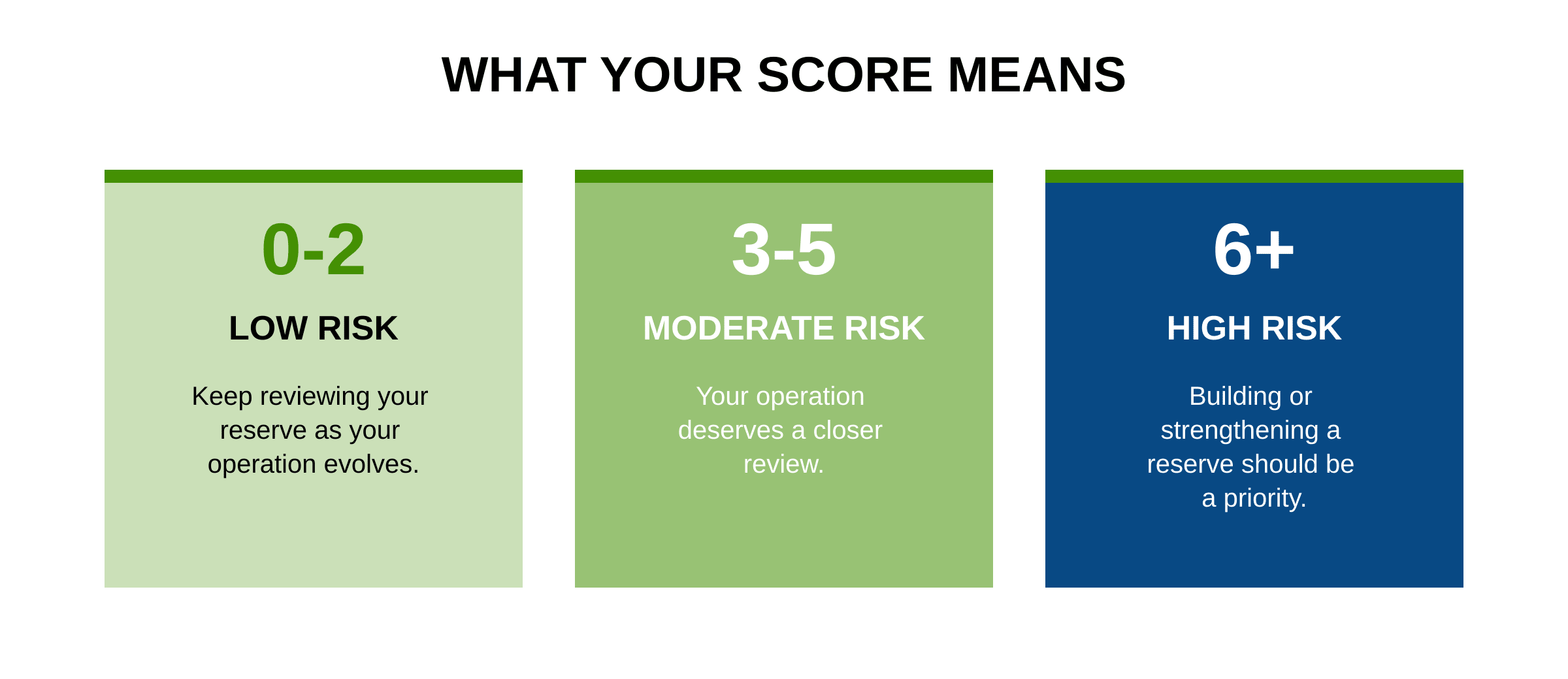
The DPF Guys Maintenance Reserve Self-Assessment
Take a few minutes and honestly evaluate your operation. Check every statement below that applies to you.
Equipment
Business
Your score: 0 of 10
Check the statements above that apply to your operation to see your result.
Five Questions Every Trucking Business Should Ask Every Month
At the end of each month, ask yourself:
- Did my truck earn enough to replace the life it consumed this month?
- Has anything changed about how I truck that increases my maintenance risk?
- Am I preparing for major repairs before they become urgent?
- If my truck required a significant repair tomorrow, could I authorize it immediately?
- Is my maintenance reserve growing with my business?
Those five questions are more valuable than almost any universal rule of thumb you’ll find online, because they’re based on your business, not someone else’s.
Okay, How Much Should You Actually Save?
That’s the question sitting underneath everything so far, and it deserves a real answer instead of a slogan.
Start with the honest part. There is no single correct number. Anyone who hands you one flat rate for every truck in America is guessing, rounding, or selling something.
What does exist is a range, and the range comes from real data.
Each year the American Transportation Research Institute publishes its Analysis of the Operational Costs of Trucking, the most widely cited benchmarking study in the industry. In 2023, the industry average for repair and maintenance came out to just over 20 cents per mile. In 2024 it dipped slightly, to just under 20 cents. In 2025 it jumped again, rising 8.6 percent to roughly 21.5 cents per mile.
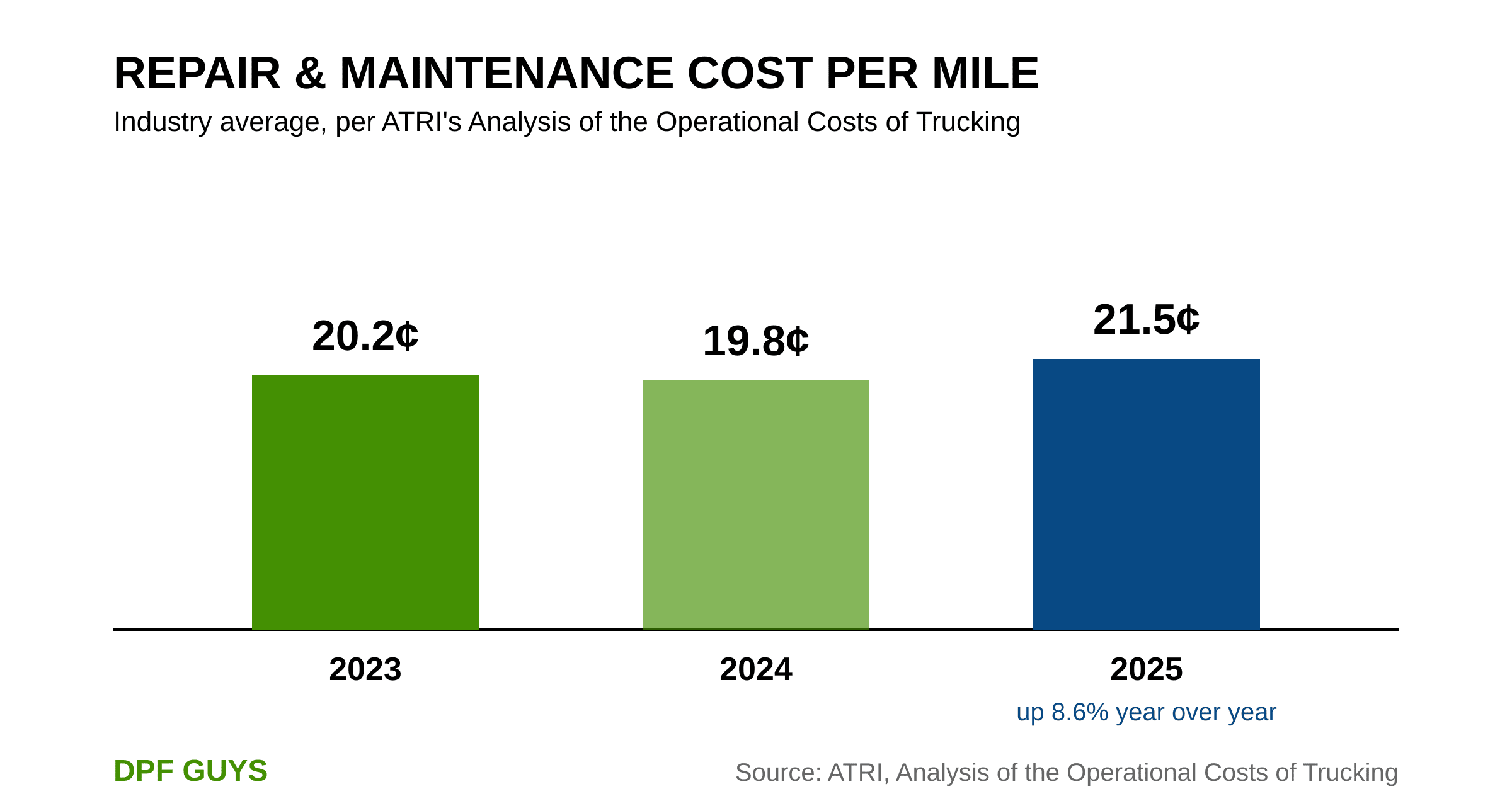
Those numbers aren’t a guess, and they aren’t pulled from one source either. ATRI builds them from direct carrier surveys combined with maintenance data feeds from Decisiv, the American Trucking Associations’ Technology and Maintenance Council, Fullbay, and Motor Information Systems. Several independent measurements get blended into one industry figure.
That blending is also why the number moves depending on who you ask and which slice of the industry you’re looking at. In the same ATRI dataset, small truckload carriers running fewer than five trucks averaged about 16 cents per mile in repair and maintenance costs. Small specialized carriers running fewer than five trucks averaged about 25 cents per mile. Same report. Same year. A nine cent per mile gap between two segments.
American Truck Business Services, which handles tax and accounting for thousands of owner-operators directly, found their clients averaging closer to 13 cents per mile, and generally recommends setting aside somewhere between 7 and 15 cents per mile.
Why does that number run lower than the broad ATRI average? Fleet-wide figures include every truck on the road, every age, every duty cycle, every level of deferred maintenance. Owner-operators watching their own equipment closely, running newer trucks, and catching small problems early will often spend less per mile than the industry blend suggests. Someone running a 14-year-old truck in vocational service will spend more. Both are correct. They’re just describing different trucks.
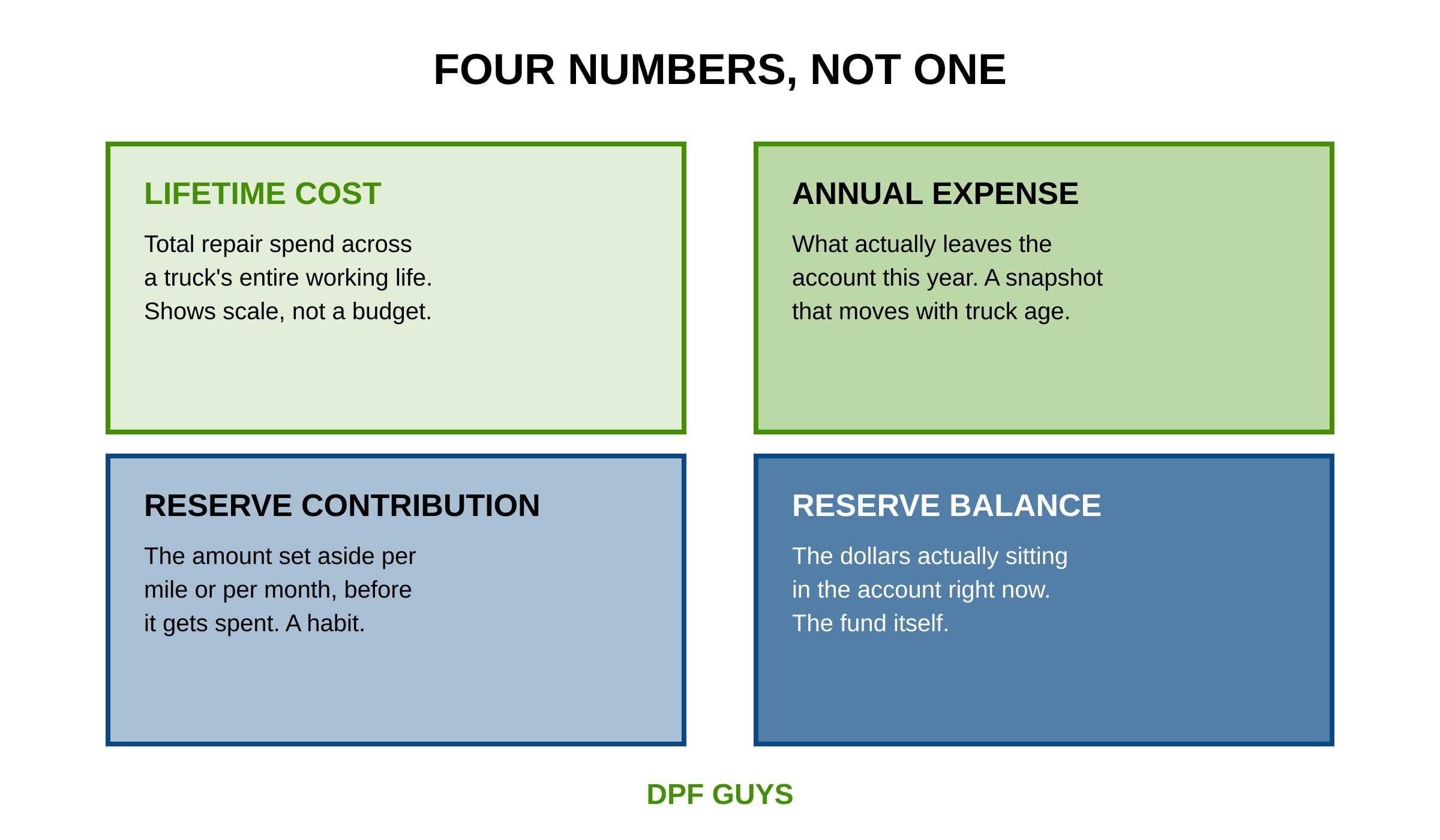
Before any of these numbers become useful, it helps to separate four ideas that get talked about as if they’re one thing.
Lifetime maintenance cost. This is the total repair and maintenance spend a truck will need across its entire working life. ATRI’s 2025 data found trucks now running an average of 633,772 miles before replacement, nearly 50,000 miles more than the year before. Multiply that mileage by the 2025 industry rate of roughly 21.5 cents per mile, and you get a rough lifetime figure north of $130,000. That number isn’t a prediction for any specific truck. It exists to show scale, not to set anyone’s budget.
Annual maintenance expense. This is what actually leaves your account in a given year. It moves constantly. A two-year-old truck under warranty might cost a few thousand dollars a year. A twelve-year-old truck out of warranty, especially one patched together with shortcuts like DIY DPF cleaning instead of proper service, can cost many times that. Annual expense is a snapshot, not a target.
Maintenance reserve contribution. This is the amount you deliberately set aside per mile or per month, going forward, before the money gets spent on anything else. It’s a habit, not a summary. It’s the number from the ATRI and ATBS data above, applied to your own truck.
Maintenance reserve balance. This is the actual dollar amount sitting in the account right now. It’s the fund itself, built one contribution at a time, and drawn down when a real repair happens.
Most confusion around maintenance reserves comes from mixing these four up. A fleet average cost per mile is not your contribution rate. Your contribution rate is not your balance. Your balance is not a lifetime cost. Keeping them separate is what makes the whole system work.
How You Truck Decides Your Number
DPF Guys has said it from the start: how you truck determines what you need, not a chart pulled from someone else’s fleet. The published ranges above are a starting point. These factors are what move you up or down inside that range.
- Truck age. Newer trucks carry lower risk and lower cost. Older trucks need a larger cushion.
- Mileage. High-mileage trucks are closer to major component replacement, whether or not anything has failed yet.
- Engine hours. For vocational and PTO-heavy work, hours matter as much as miles, sometimes more.
- Warranty status. A truck still under warranty needs a smaller reserve than one carrying every risk alone.
- Duty cycle. Long-haul highway miles wear a truck differently than stop-and-go regional or vocational work, and it changes how often the truck needs a properly optimized regeneration cycle.
- Idle percentage. Heavy idling adds wear without adding miles, and it belongs in the calculation, since extending the time between cleanings depends partly on keeping idle time in check.
- Vocational versus highway service. Severe-duty applications, refuse, construction, heavy haul, cost more to maintain than a dry van running interstate miles.
- Maintenance history. A truck with a documented sensor and trouble-code history is a more predictable truck. One with unknown history, especially a used purchase, carries hidden risk.
- Operating environment. Heat, cold, dust, road salt, and terrain all shift the number, sometimes significantly.
None of these factors change the concept. They change where you land inside the range those published numbers describe.
Suppose you run a truck at 100,000 miles a year. Using a contribution rate toward the middle of the published ranges, somewhere around 20 to 25 cents per mile depending on age and duty cycle, that’s $20,000 to $25,000 a year flowing into the reserve. Over time, depending on how the account was built and how it has already absorbed repairs, a reserve target in the neighborhood of $30,000 for a single truck isn’t unusual. That figure isn’t universal. It’s simply what one reasonable set of assumptions produces for one truck.
Which raises the next question. What happens once you actually get there?
What Happens When Your Reserve Is Full?
The answer surprises a lot of people.
You don’t stop saving. You simply stop putting the money in the same place.
Many people assume a maintenance reserve has a finish line. It doesn’t. A maintenance reserve has a target. Once you reach that target, every additional dollar simply gets a new job.
Let’s stay with the example above. Suppose you’ve determined that $30,000 is the appropriate maintenance reserve for your truck, based on its age, mileage, duty cycle, warranty status, and operating conditions. As your truck earns revenue, you keep setting aside your maintenance contribution every mile, the same habit described above.
Eventually the reserve reaches its target balance. Now something changes.
Every new dollar that would have gone into the Maintenance Reserve is redirected into a second account: a Replacement Fund.
You now have two financial buckets working together.
Bucket one: the Maintenance Reserve. This account exists for one purpose. Keeping your current truck working.
Bucket two: the Replacement Fund. This account exists for one purpose. Helping pay for the truck that will eventually replace the one you’re driving today.
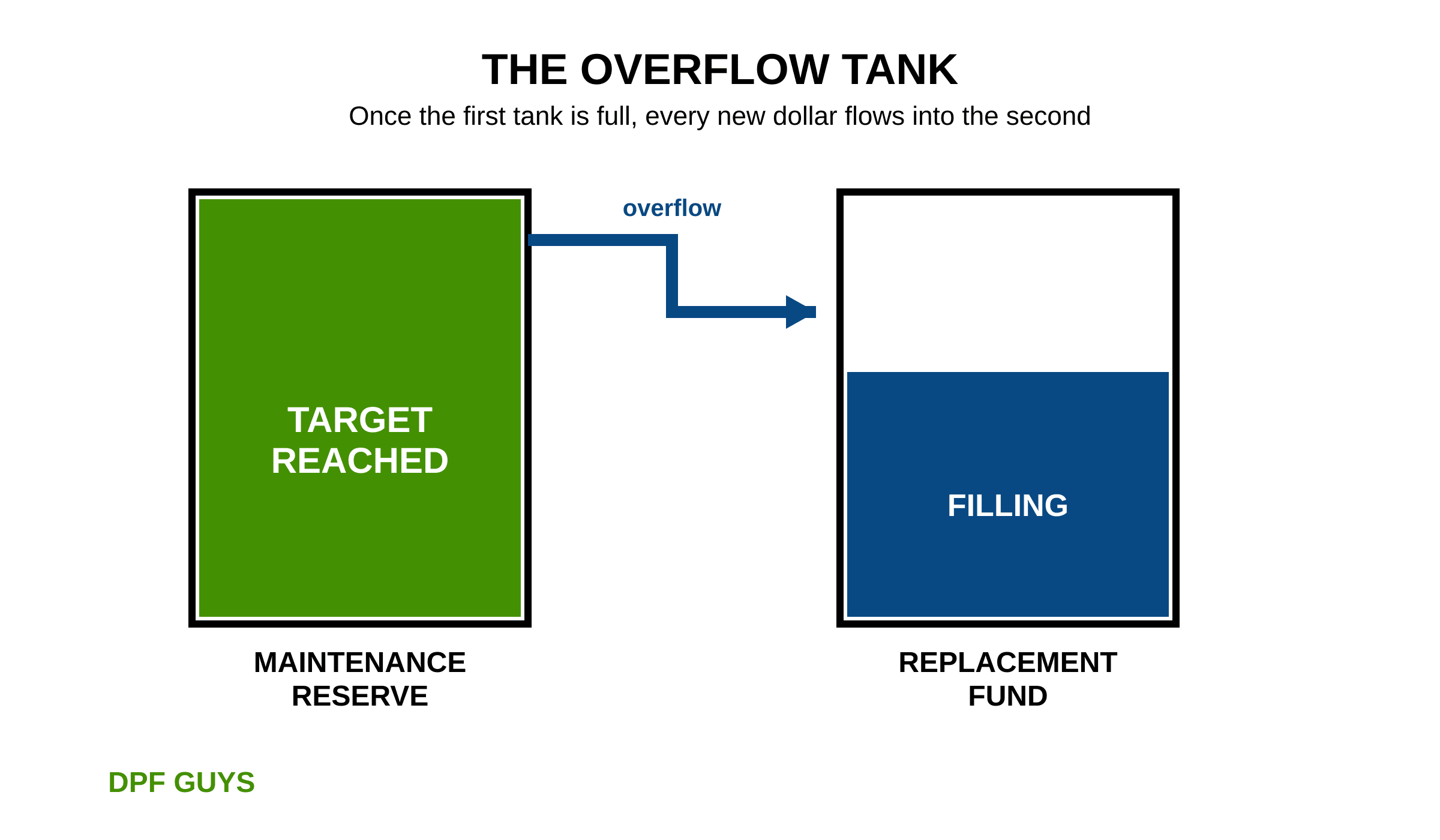
Picture a water tank with an overflow pipe. The first tank has to stay full. Once it reaches its target level, every additional gallon automatically flows into the second tank. Money works the same way. The Maintenance Reserve is the first tank. The Replacement Fund is the overflow. As long as the first tank stays full, every mile begins helping pay for your next truck.
Now suppose six months later you have a major repair. A transmission. An engine overhaul. A turbocharger and a full aftertreatment replacement. The repair costs $12,000. You pay for it out of the Maintenance Reserve. The balance drops from $30,000 to $18,000.
What happens next is nothing complicated. The money that had been flowing into the Replacement Fund gets temporarily redirected back into the Maintenance Reserve until it reaches its target balance again. Once the reserve is full, new contributions start flowing into the Replacement Fund once more.
The habit never changes. You never stop saving. You simply change where the next dollar goes.
This matters more than it sounds like it should. Many owner-operators finally pay off their truck and suddenly have more cash flow than they’ve had in years. That’s often exactly when they stop saving. The truck is paid for. Business is good. The extra cash quietly disappears into everyday spending. A few years later, the truck needs to be replaced. The maintenance reserve may still be healthy, but there’s little money available for the next truck, and the cycle starts over.
This approach breaks that cycle. Every mile first protects today’s truck. Once today’s truck is financially protected, every additional mile begins helping pay for tomorrow’s truck. Over time, the truck doesn’t just pay for its own maintenance. It helps buy its own replacement. That’s how many successful fleets already think. There’s no reason an owner-operator can’t think the same way.
The goal was never to build the largest maintenance reserve possible. The goal is to keep your current truck financially protected while continuously building capital for the truck that comes next. Never stop saving. Simply give every dollar the job your business needs most right now. Today that job may be protecting your truck. Tomorrow it may be helping you replace it. Either way, every mile is still paying for the next one.
A Final Thought
At DPF Guys, we believe commercial trucks deserve better than reactive maintenance. We believe owner-operators deserve better information than generic advice found on internet forums and social media. Most importantly, we believe every commercial vehicle should be managed as the revenue-producing business asset it truly is.
Whether you operate:
- An over-the-road tractor
- A box truck
- A refuse truck
- A transit bus
- A utility truck
- A heavy-haul tractor
- Or an entire fleet
The principle never changes. Every mile should contribute something toward replacing the life that was consumed earning that mile.
That’s how fleets think. That’s how resilient trucking businesses survive difficult years. And that’s how small problems stay small.
- The next time you fuel your truck…
- The next time you deposit a settlement…
- The next time another thousand miles disappear from the odometer…
Don’t just ask,
“How much did I make today?”
Ask the question that matters far more.
Did my truck earn enough today to pay for tomorrow?
If the answer is yes, you’re no longer simply operating a truck. You’re building a stronger trucking business. And that may be the most profitable investment you’ll ever make.