
“DOT Doesn’t Care About Emissions”?
Inside Modern CVSA Inspections, Exhaust Checks, and the Myth of the “Perfect Delete”
Spend enough time on any trucking forum, diesel Facebook group, or YouTube comment section and you will find some version of the same claim: “DOT doesn’t care about emissions.” It circulates as common knowledge. Drivers repeat it. Shop owners pass it along. Fleet managers hear it and wonder whether to take it seriously.
The claim is not entirely invented. Enforcement is genuinely inconsistent across regions and agencies. But the conclusion most people draw from it, that roadside inspectors either cannot or will not notice emissions-related issues, is significantly more optimistic than reality supports.
This article examines what DOT inspections actually include, how they work at the roadside level, and why the belief that a deleted truck is effectively invisible to enforcement is based on a misreading of how the inspection system operates.
What Are DOT Inspection Levels?
The Commercial Vehicle Safety Alliance (CVSA) establishes standardized inspection procedures for commercial motor vehicles throughout North America. These procedures define what inspectors examine at each level. The Federal Motor Carrier Safety Administration (FMCSA) incorporates CVSA inspection standards into federal compliance programs.
There are eight recognized inspection levels. Each is designed for a specific context and scope.
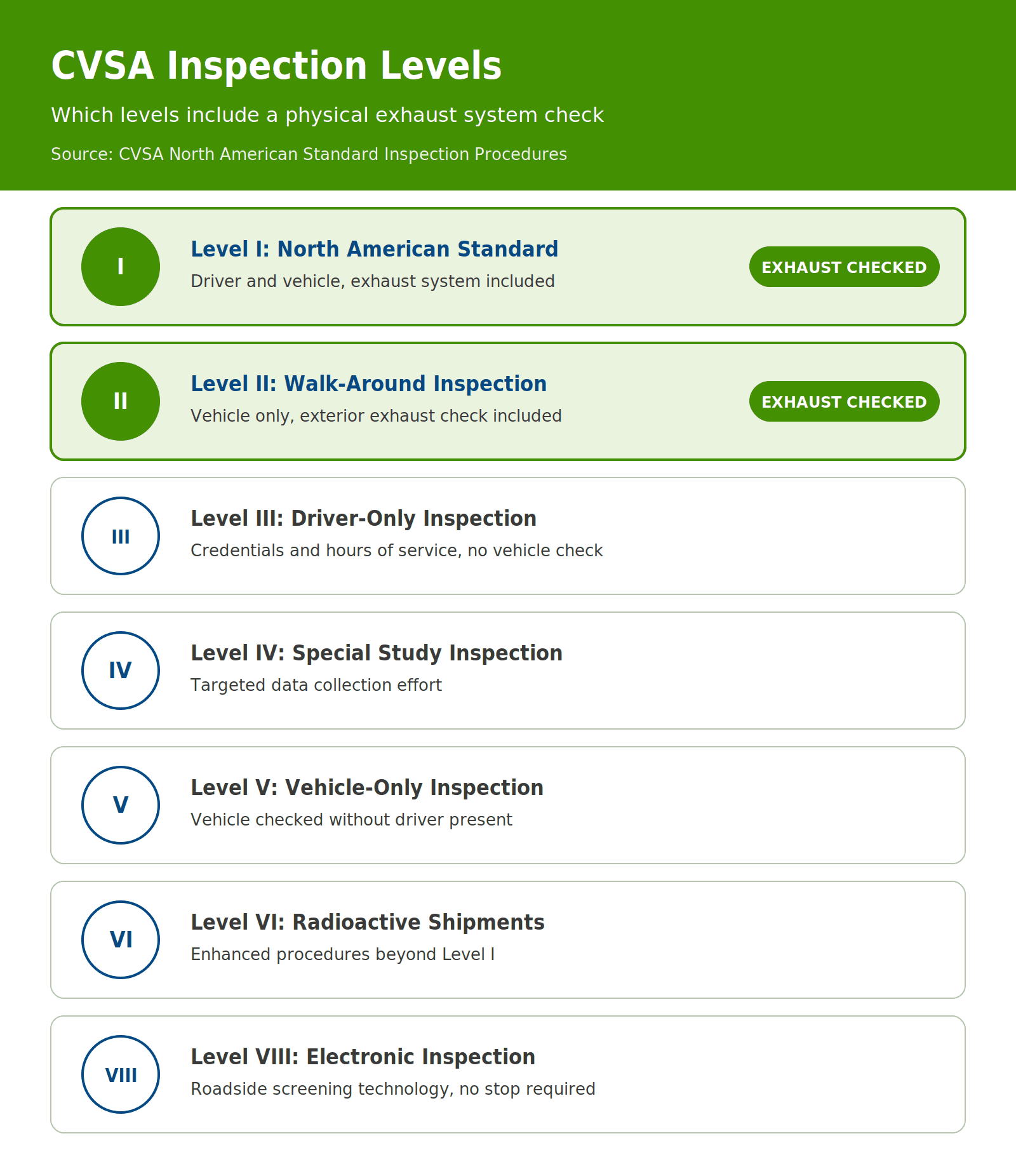
Level I: North American Standard Inspection
Level I is the most comprehensive roadside inspection. It covers both the driver and the vehicle. According to CVSA documentation, Level I includes a physical walk-around examination of the vehicle that explicitly covers the exhaust system.
Inspectors examine brake systems, coupling devices, exhaust systems, frames, fuel systems, lighting, steering, suspension, tires, van and open-top trailer bodies, wheels and rims, and windshield wipers. Driver documentation, including the commercial driver’s license, medical certificate, hours-of-service records, and hazardous materials paperwork where applicable, is also reviewed.
The exhaust system inspection during Level I includes checking for leaks, damage, and improper routing. Inspectors look at the physical configuration and condition of exhaust components.
Level II: Walk-Around Driver and Vehicle Inspection
Level II covers most of the same vehicle components as Level I but without requiring the inspector to go under the vehicle. It still includes an exterior examination of exhaust system components that are visible without going underneath.
This level is commonly used when a full Level I inspection is not practical at a particular location.
Level III: Driver-Only Inspection
Level III focuses exclusively on driver credentials, hours of service, and documentation. It does not include a vehicle inspection. However, a Level III inspection can escalate if observable vehicle conditions raise concerns.
Level IV: Special Study Inspection
Level IV inspections are targeted inspections designed around a specific study or data collection effort. They are typically conducted as part of coordinated enforcement programs.
Level V: Vehicle-Only Inspection
Level V inspections cover the vehicle without the driver present. These are often conducted at terminal locations or facilities.
Level VI: Enhanced NAS Inspection for Radioactive Shipments
Level VI applies specifically to vehicles transporting certain radioactive materials. It involves enhanced procedures beyond the standard Level I inspection.
Level VIII: Electronic Inspection
Level VIII uses electronic screening technology, such as transponders, weigh-in-motion systems, and roadside monitoring equipment, to conduct a preliminary review without requiring the driver to stop. Vehicles that do not pass electronic screening may be directed to a weigh station or inspection site for further review. California’s Clean Truck Check program is a real-world example of this kind of screening extending specifically into emissions, using roadside monitoring devices that flag high-emitting trucks without stopping them.
Key Takeaway: Exhaust Systems Are Explicitly Included
Level I and Level II inspections include a physical examination of the exhaust system. This is not a new development or a special enforcement initiative. It is part of the standard CVSA inspection procedure.Sources: CVSA North American Standard Inspection Procedures; FMCSA inspection reference materials.
Can a Lower Level Inspection Turn Into a Higher Level Inspection?
Yes. Roadside inspections are dynamic. They are not fixed scripts that inspectors follow from start to finish regardless of what they observe.
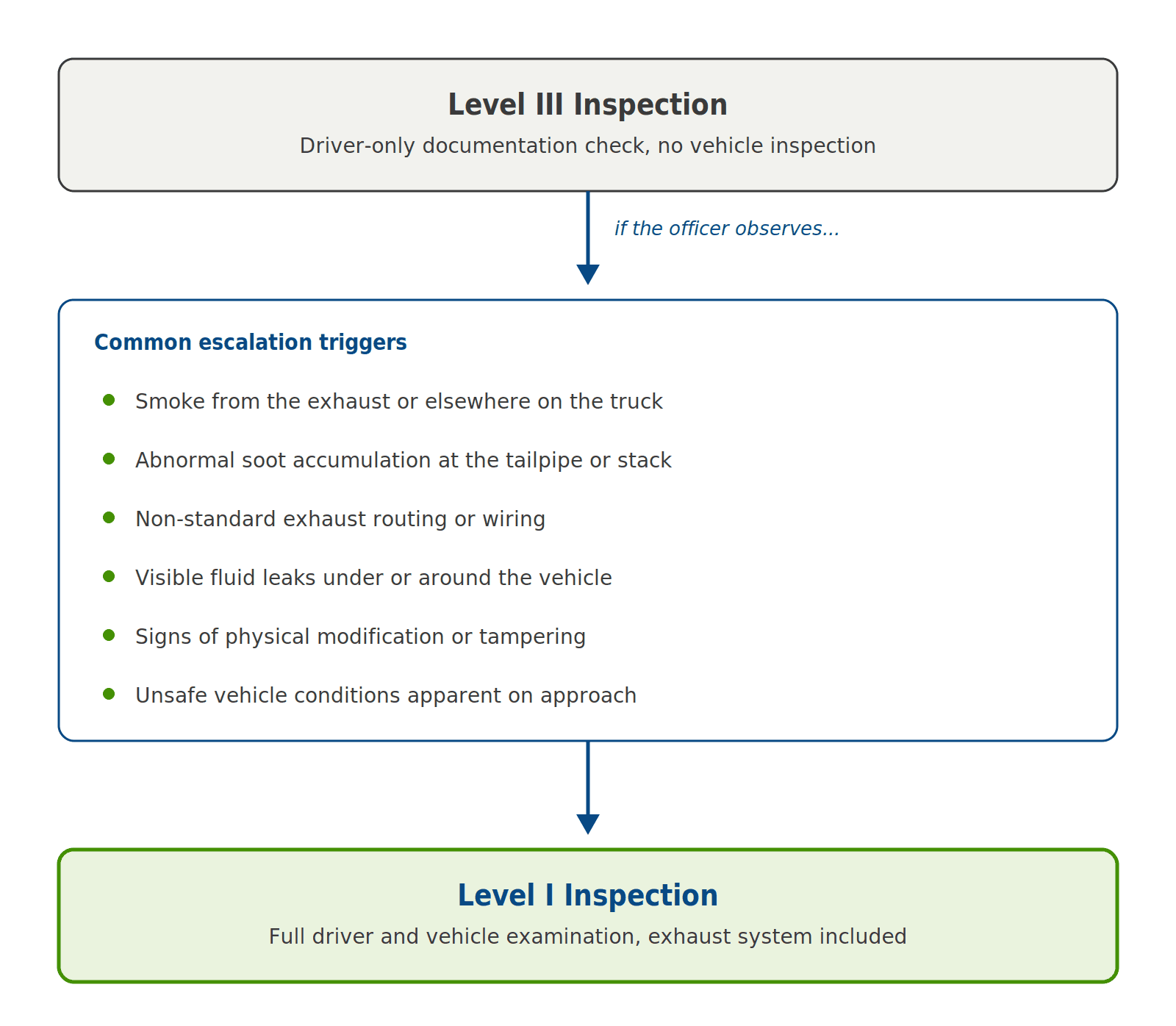
A Level III inspection, which starts as a driver-only documentation check, can escalate into a full Level I vehicle inspection if the officer observes conditions that warrant a closer look. The scope of an inspection is ultimately driven by what the inspector observes during the encounter.
CVSA and FMCSA guidance describes roadside inspections as discretionary and observational. Officers are trained to notice abnormalities. Common triggers for escalation include:
- Visible fluid leaks under or around the vehicle
- Smoke coming from the exhaust or elsewhere on the truck
- Loose, hanging, or missing components
- Abnormal soot accumulation at the tailpipe or stack
- Inconsistencies in paperwork or driver credentials
- Signs of physical modification or tampering
- Unsafe vehicle conditions apparent on approach
- Unusual wiring, altered components, or non-standard exhaust routing
An inspection that begins as routine documentation review can become a full vehicle inspection based on nothing more than what the officer sees while walking around the truck. That dynamic is part of why enforcement attention increasingly extends beyond the roadside stop itself, and why deleted, defeated, or illegally tuned emissions systems carry more exposure than the “invisible if it’s quiet” logic assumes.
How Escalation Works in Practice
Roadside inspections are not passive. Officers are trained to observe while they check documents, walk from their vehicle to the cab, and conduct initial conversations. Anything that creates a visual or sensory abnormality can shift the scope of what happens next.There is no regulatory requirement that an officer ignore an obvious problem simply because the inspection started at a lower level.
The Myth of the “Perfect Delete”
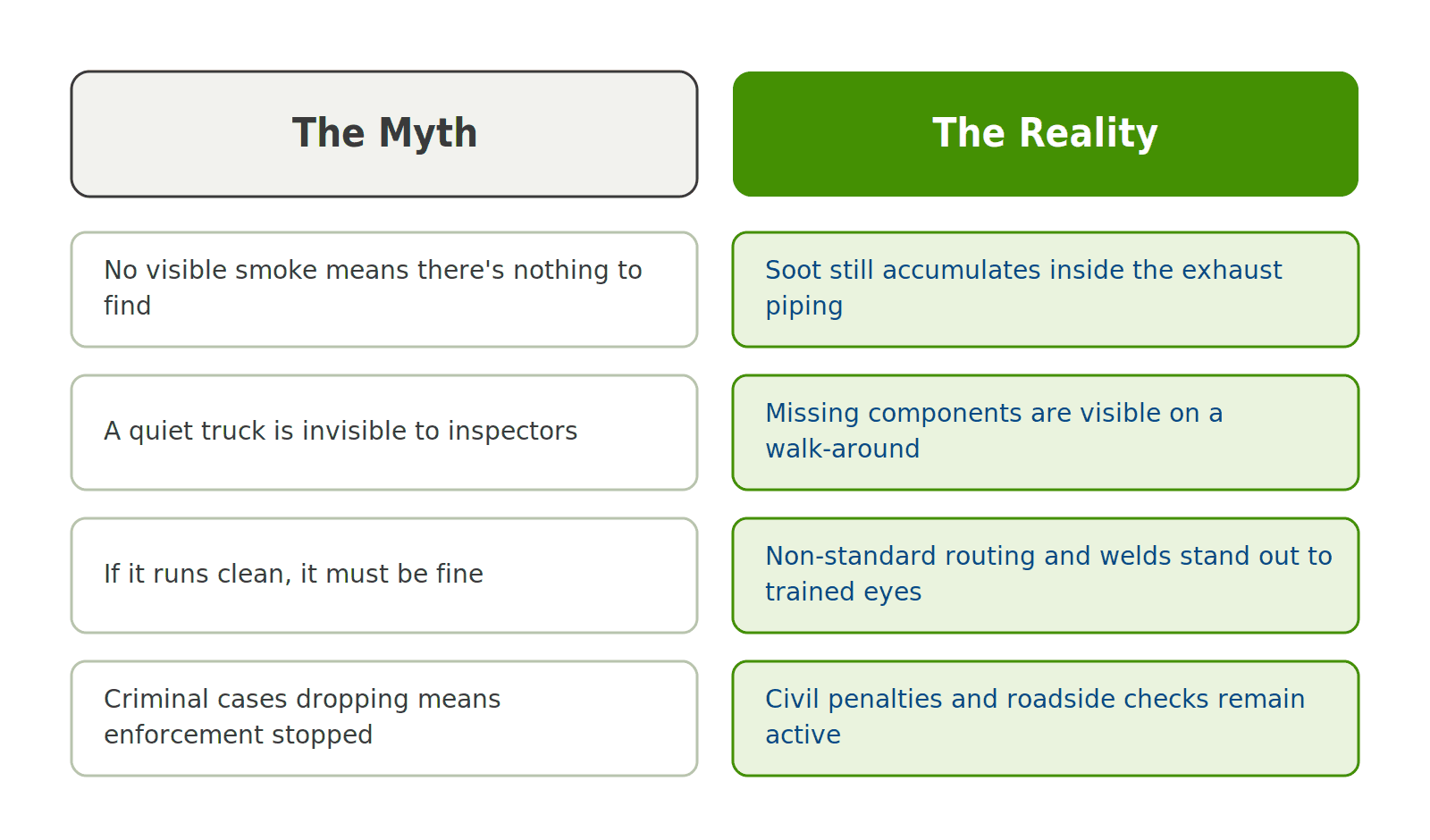
Online communities that discuss diesel emissions delete kits often include confident claims that a well-executed delete is essentially invisible. The logic goes something like this: if there is no visible smoke and the truck runs cleanly, there is nothing for an inspector to find.
That framing misunderstands how modern diesel aftertreatment systems work, and what they are designed to do. It also doesn’t hold up against independent data on what deleted trucks actually emit, which tells a different story than the “runs clean, so it’s fine” assumption.
What a Properly Functioning Aftertreatment System Actually Does
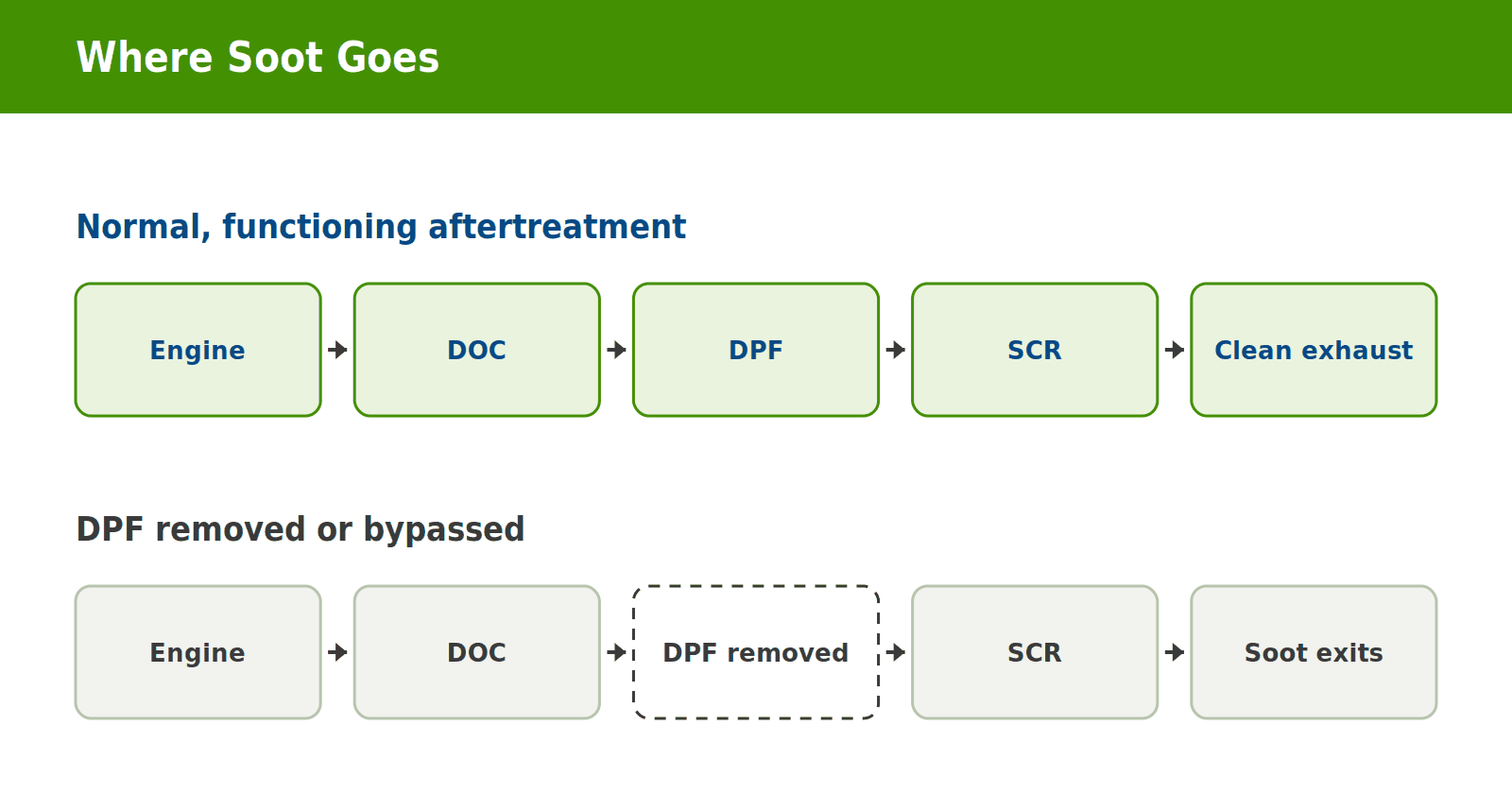
A modern diesel emissions system is not designed to merely reduce soot at the tailpipe. It is designed to capture particulate matter before it ever reaches the outlet of the exhaust system.
Under normal operation with a fully intact and properly functioning aftertreatment system, modern diesel exhaust is composed primarily of nitrogen, water vapor, carbon dioxide, and oxygen. The Diesel Particulate Filter (DPF) traps particulate matter within the filter substrate. Selective Catalytic Reduction (SCR) systems dramatically reduce nitrogen oxide (NOx) emissions through a chemical reaction using Diesel Exhaust Fluid (DEF). According to EPA certification data, modern EPA-compliant heavy-duty diesel engines can achieve NOx reductions of more than 90 percent compared to uncontrolled older diesel engines under certified operating conditions.
What Happens When Aftertreatment Is Removed
When a DPF is removed, gutted, bypassed, or otherwise defeated, particulate matter is no longer captured as designed. The diesel combustion process produces soot as a normal byproduct. Without functional filtration, that soot exits through the exhaust system.
Over time, soot accumulates within the exhaust piping and becomes visible at the tailpipe or stack. The degree of accumulation depends on the engine, fuel quality, load cycles, and other operating factors. But the underlying dynamic is consistent: soot that would have been captured inside the DPF substrate now has a clear path to the atmosphere, which is part of why a delete tends to trade a short-term hassle for a much larger, more expensive problem down the road.
Soot Is a Symptom, Not a Diagnosis
Visible soot accumulation at the tailpipe of a modern emissions-equipped diesel engine is not, by itself, proof of intentional tampering. That distinction is important.
A damaged, cracked, melted, or otherwise failed DPF can allow particulate matter to bypass filtration and exit through the exhaust system even when no intentional modification has occurred. Other mechanical conditions can also produce elevated soot at the outlet, including:
- Failed or cracked DPF substrate
- Turbocharger problems causing oil to enter the exhaust stream
- Injector issues affecting combustion quality
- Excessive engine oil consumption
- Poor combustion from fuel quality or compression problems
- Failed sensors causing incorrect regeneration cycles
- DEF system or SCR-related faults
- Combinations of multiple upstream mechanical failures
In other words, soot at the outlet of a modern emissions-equipped diesel engine is a symptom. The cause of that symptom may involve mechanical failure, neglect, or intentional tampering.
Regardless of the cause, the underlying problem requires correction, because the emissions system is no longer functioning as designed. That is true whether the cause is a failed DPF substrate or a physically removed aftertreatment device.
What Visual Indicators Can Reveal
Inspectors do not need laboratory instruments to notice certain conditions. Soot patterns, exhaust staining, odor, and physical modifications can all become observable during a walk-around inspection.
Conditions that can draw attention during a roadside inspection include:
- Visible black residue or heavy staining around the tailpipe or stack outlet
- Excessive exhaust staining on the body of the vehicle near the exhaust outlet
- Visible smoke during startup, idle, acceleration, or deceleration
- Strong or unusual diesel exhaust odor
- Non-standard exhaust routing that differs from the manufacturer configuration
- Missing or physically altered components in the aftertreatment area
- Abnormal welds, patches, or pipe modifications where filter housings would normally be located
- Empty filter canisters or canisters that do not match vehicle specifications
- Missing DEF tank, DEF lines, or dosing hardware
- Disconnected or visibly modified sensor connections
None of these observations automatically proves emissions tampering. But each can provide a basis for an inspector to look more closely at the exhaust and aftertreatment system.
Important Legal Note
Visible soot is not proof of tampering. It is an observable condition that may justify further investigation. If further inspection reveals evidence of intentional emissions modification, such as physically removed components, altered wiring, defeat devices, or unauthorized ECM tuning, the situation can move from a maintenance issue into potential regulatory enforcement exposure.Depending on the jurisdiction and the agencies involved, findings of illegal emissions tampering can result in required repairs, failed inspections, out-of-service conditions, compliance orders, or civil penalties under federal or state law.
Why “DOT Doesn’t Care” Became So Common
The belief did not come from nowhere. There are real factors that contributed to it.
Inconsistent Enforcement
Roadside emissions enforcement varies significantly by state, by agency, and by individual officer. Not every inspector pays equal attention to aftertreatment components. Some states have more active emissions enforcement programs than others. Some inspection stations focus primarily on safety-of-operation issues and spend less time on exhaust system details. That inconsistency is real.
Resource Limitations
CVSA-certified inspectors are primarily safety inspectors. They are trained to identify conditions that create immediate safety risks, brake failures, tire blowouts, unsecured cargo, lighting violations, and driver hours-of-service violations. Emissions analysis is not the primary focus of most roadside inspection programs, and detailed emissions testing equipment is not standard roadside equipment.
Viral Misinformation
Social media has amplified the belief significantly. Posts claiming that an officer “didn’t even look at” the exhaust, or that a truck “passed inspection no problem” with aftertreatment components removed, spread quickly through diesel communities. What these accounts rarely capture is the full context of the inspection, the jurisdiction, the officer, or whether a detailed examination actually occurred.
Confusion Between Criminal and Civil Enforcement
The Department of Justice announced in 2023 that it would not prioritize criminal prosecution of individual truck owners for emissions tampering violations. That policy decision was widely reported in diesel media and was interpreted by many as a general signal that emissions enforcement had ended.
That interpretation was incorrect. A decision not to pursue criminal charges against individual owners is not the same as a decision to stop enforcing civil emissions regulations. The EPA’s civil enforcement authority under the Clean Air Act remains intact. State-level enforcement programs remain active in many jurisdictions. And CVSA roadside inspection procedures still include exhaust system examination.
Misunderstanding What Inspectors Are Checking
Many truck owners visualize a roadside inspection as a pass/fail emissions test with analytical equipment. That is not how most roadside inspections work. Inspectors are conducting visual and physical examinations. They are trained observers, not laboratory technicians.
The relevant question is not whether an inspector has an opacity meter. The relevant question is whether an inspector is trained to notice abnormalities in the exhaust system during a walk-around, and the answer to that question, under CVSA standards, is yes.
A Reduction in Criminal Prosecution Is Not Legalization
Emissions tampering remains illegal under federal law regardless of current prosecutorial priorities. The Clean Air Act prohibits tampering with emissions controls on motor vehicles (42 U.S.C. § 7522). Civil penalties under the Act can reach tens of thousands of dollars per violation.State law in many jurisdictions adds additional prohibitions and penalties on top of federal law.
Why Fleets Should Pay Attention
For individual owner-operators, the risks discussed in this article are real but may feel abstract. For fleets operating multiple vehicles, the exposure is multiplied.
CSA Score Implications
The FMCSA’s Compliance, Safety, Accountability (CSA) program tracks inspection violations and assigns them to carriers. Violations accumulate in BASIC (Behavior Analysis and Safety Improvement Category) scores that affect a carrier’s safety rating. Exhaust system violations discovered during roadside inspections contribute to a carrier’s Vehicle Maintenance BASIC score.
A pattern of violations across a fleet can elevate CSA scores to levels that trigger FMCSA intervention, affect shipper relationships, and damage the carrier’s safety record. For fleets, staying ahead of those scores generally comes down to consistent, documented compliance practices rather than reacting after a violation is already on the record.
Out-of-Service Risk and Roadside Downtime
A vehicle placed out of service at a roadside inspection cannot move until the cited condition is corrected and cleared. For a single truck, that can mean hours or days of lost revenue. For a fleet experiencing a systematic aftertreatment issue across multiple units, the cumulative downtime cost can be substantial.
Liability Exposure
Emissions tampering removes a component that the vehicle manufacturer certified as part of the vehicle’s legal configuration. If a vehicle with altered emissions controls is involved in an incident, the modification can become a factor in civil litigation. Demonstrating that a fleet knowingly operated vehicles with defeated emissions systems creates documentation of intentional non-compliance.
State Inspection Programs
Many states require periodic safety inspections for commercial motor vehicles. State inspection programs vary, but some include exhaust system examinations that extend beyond what a roadside spot check covers. A truck that has passed multiple roadside spot checks can still fail a state inspection station examination if aftertreatment components are missing or modified.
Resale Complications
Trucks with physically removed or altered aftertreatment systems face complications at resale. Buyers conducting due diligence, particularly commercial fleet buyers, increasingly check aftertreatment system integrity. Restoring a deleted truck to legal configuration involves parts, labor, and potential ECM recalibration, costs that reduce the truck’s effective resale value well beyond whatever the delete itself was meant to save.
What DOT Inspectors Actually See Every Day
A commercial vehicle inspector working a busy interstate checkpoint or weigh station sees hundreds of trucks per week. That volume creates something that laboratory equipment cannot replicate: pattern recognition built on direct observation.
Inspectors walk around trucks. They look at tires, lights, coupling hardware, and brake components. They also look at exhaust outlets. They smell exhaust. They notice staining on vehicle bodies. They compare what they see against what is normal for a particular truck type, model year, and configuration.
A truck from a model year that was manufactured with a DPF and SCR system has a known configuration. If the aftertreatment canisters in the expected location look wrong, too light, too shiny, improperly connected, or simply absent, that observation is available to any inspector who has seen the same platform dozens of times.
Soot staining around the exhaust stack of a newer truck is similarly notable. On a well-maintained, properly functioning modern diesel, the exhaust outlet area is relatively clean. Heavy black soot deposits on a truck that should be producing nearly clean exhaust is the kind of anomaly that experienced inspectors notice.
None of this requires specialized equipment. It requires attention and repetition, both of which experienced inspectors have in abundance.
What Experience Teaches
Inspectors who work high-volume roadside locations develop an eye for what normal looks like on specific truck configurations. A missing DEF tank on a post-2010 truck, an unusual pipe configuration where a filter housing should be, or a fresh weld on an exhaust component on an older-looking truck are all things that stand out to an experienced observer.The belief that a truck is invisible to inspection because it is not actively blowing smoke underestimates what observational training produces over time.
Frequently Asked Questions
The following questions reflect common searches and inquiries from truck owners, fleet managers, and diesel technicians. Answers are written to provide direct, accurate responses consistent with CVSA and FMCSA guidance.
Can DOT inspect your exhaust system?
Yes. Exhaust system inspection is explicitly included in CVSA Level I and Level II North American Standard Inspection procedures. Inspectors examine exhaust system components for leaks, damage, improper routing, and visible abnormalities as part of a standard roadside vehicle inspection.
Is the exhaust system part of a Level I inspection?
Yes. According to CVSA North American Standard Inspection procedures, the exhaust system is one of the vehicle components examined during a Level I inspection. This includes a physical examination of exhaust system components visible from the exterior of the vehicle and from underneath.
Can DOT tell if a truck is deleted?
Potentially, yes. Inspectors are trained to conduct visual walk-around examinations. Missing aftertreatment components, non-standard exhaust routing, abnormal soot accumulation, unusual welds or modifications, and absent DEF system hardware are all observable conditions. No specialized laboratory equipment is required to notice physical modifications to an exhaust system.
Does soot on the tailpipe mean a truck is deleted?
Not necessarily. Visible soot accumulation on the exhaust outlet of a modern emissions-equipped diesel engine is a symptom that the aftertreatment or combustion system is not functioning correctly. The cause may involve mechanical failure, such as a cracked DPF substrate, injector problems, or turbocharger issues, as well as intentional emissions tampering. Soot is an indicator that something is wrong, not a definitive diagnosis of the cause.
Are deleted trucks still illegal?
Yes. Emissions tampering is prohibited under the federal Clean Air Act (42 U.S.C. § 7522), which makes it unlawful to tamper with or defeat emissions control devices on motor vehicles. This prohibition applies regardless of current federal criminal prosecution priorities. Civil enforcement authority under the EPA remains in effect, and state law in many jurisdictions adds additional prohibitions.
Can a Level III inspection become a Level I?
Yes. Roadside inspections are dynamic. A Level III inspection, which begins as a driver-only documentation check, can escalate into a full Level I vehicle inspection if the officer observes conditions during the initial encounter that warrant a closer examination of the vehicle.
What does DOT look for during roadside inspections?
During a Level I inspection, officers examine driver credentials and documentation along with vehicle components including brakes, coupling devices, exhaust systems, frames, fuel systems, lighting, steering, suspension, tires, wheels, and windshield wipers. The exhaust system examination includes checking for leaks, damage, improper routing, and visible abnormalities.
Do DOT officers need emissions testing equipment to identify a problem?
No. Specialized emissions testing equipment, such as opacity meters or exhaust analyzers, is not required for a roadside inspector to notice visible exhaust system abnormalities. Soot accumulation, missing components, unusual exhaust routing, visible smoke, and physical modifications are all observable without laboratory instruments.
What happens if emissions tampering is discovered during a roadside inspection?
Findings vary depending on the jurisdiction, the agency involved, and the nature of the findings. Outcomes can include vehicle out-of-service orders, required repairs before the vehicle can continue, failed inspection records, referrals to EPA or state environmental enforcement agencies, compliance orders, and civil penalties. The specific consequences depend on the applicable federal and state regulations and the enforcement priorities of the agencies involved.
10 Things DOT Inspectors Notice During a Walk-Around Inspection
This is not a complete checklist of every item covered in a CVSA inspection. It is a summary of observable conditions that experienced roadside inspectors encounter regularly during walk-around examinations.
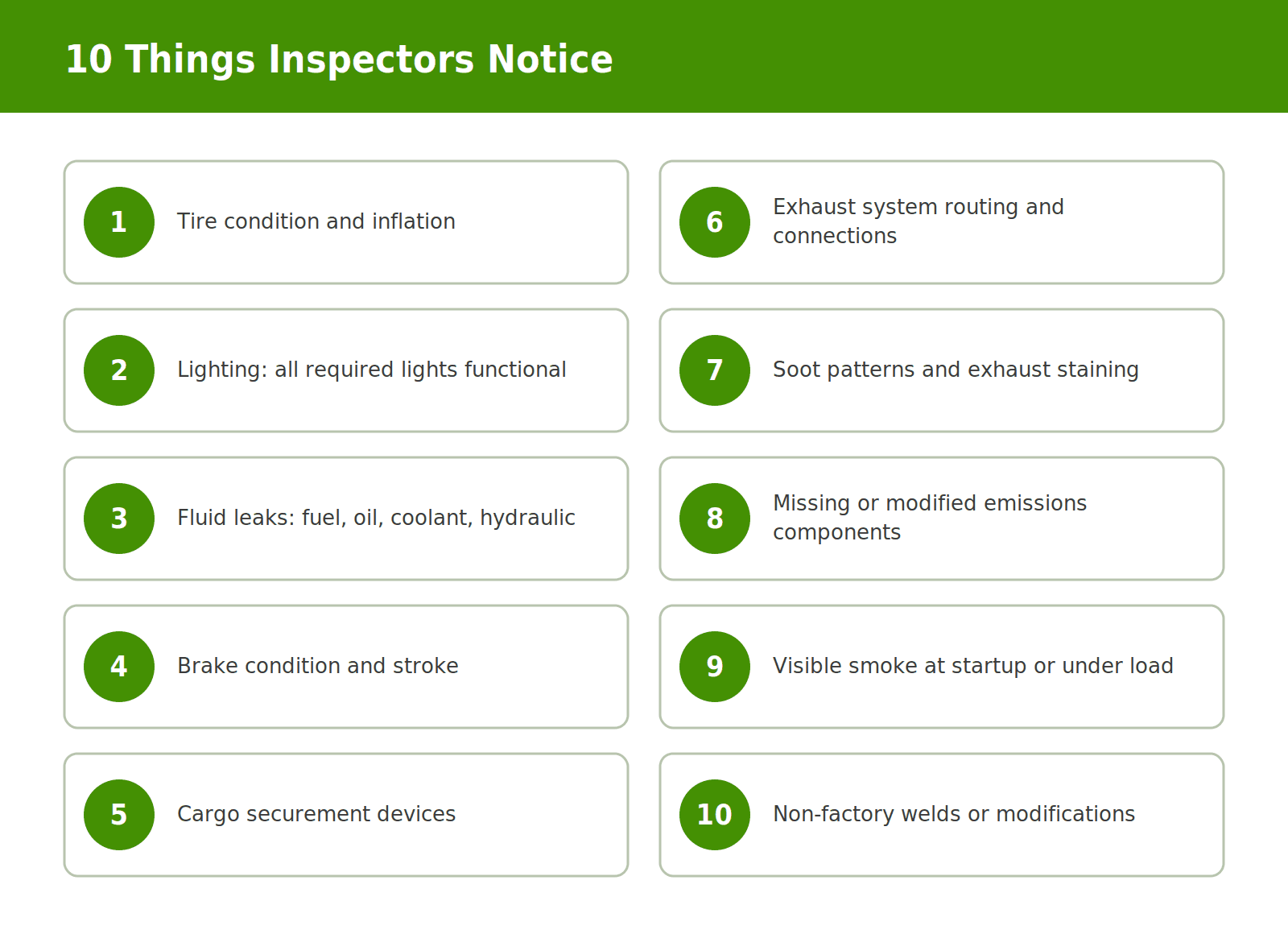
- Tire condition and inflation. Inspectors look at tread depth, sidewall damage, inflation, and signs of uneven wear. Out-of-service tire violations are among the most common roadside findings.
- Lighting. All required lights, headlights, brake lights, turn signals, clearance lights, and marker lights, must be functional. Burned-out or missing lights are immediately visible during any walk-around.
- Fluid leaks. Active leaks of fuel, oil, coolant, or hydraulic fluid are visible during a walk-around and can indicate serious mechanical problems or fire risk.
- Brake condition. Brake stroke, brake pad or shoe condition, and air brake system integrity are examined during Level I inspections. Brake violations are consistently among the top out-of-service violations nationwide.
- Cargo securement. For loaded vehicles, load securement devices, straps, chains, binders, and blocking, are visible from the exterior and examined for adequacy.
- Exhaust system abnormalities. The exhaust system is explicitly part of Level I and Level II inspections. Inspectors look at routing, connections, hangers, and condition of exhaust components.
- Soot patterns and exhaust staining. Heavy soot accumulation at the tailpipe or stack outlet, or exhaust staining on the vehicle body, is visible during a walk-around and inconsistent with normal operation of a properly functioning modern aftertreatment system.
- Missing or modified emissions components. Absent or visibly altered DPF canisters, missing DEF system hardware, disconnected sensor lines, or non-standard exhaust configurations are observable during a physical walk-around.
- Visible smoke. Smoke from the exhaust system during startup, idle, acceleration, or deceleration is observable without equipment and can prompt additional scrutiny of exhaust and engine systems.
- Unusual modifications or non-standard components. Non-factory welds, replaced components that do not match vehicle specifications, unusual pipe configurations, or other visible departures from the manufacturer’s design can attract attention during a walk-around by experienced inspectors.
The Bottom Line
The claim that DOT does not care about emissions is not entirely false, but the conclusion most people draw from it is significantly more optimistic than the inspection system actually supports.
Level I and Level II roadside inspections explicitly include exhaust system examination. Lower-level inspections can escalate based on observable conditions. Experienced inspectors develop pattern recognition that does not require laboratory equipment. And the legal prohibition on emissions tampering has not changed.
Whether a truck’s emissions system is properly maintained or has been altered, the physical evidence does not disappear simply because an inspector does not have an opacity meter in hand.
Sources and References
- CVSA North American Standard Inspection Procedures, Commercial Vehicle Safety Alliance (cvsa.org)
- FMCSA Roadside Inspection Program, Federal Motor Carrier Safety Administration (fmcsa.dot.gov)
- FMCSA CSA Program, BASIC scoring methodology and Vehicle Maintenance BASIC (ai.fmcsa.dot.gov)
- Clean Air Act Tampering Provisions, 42 U.S.C. § 7522, U.S. Environmental Protection Agency (epa.gov)
- EPA Heavy-Duty Engine and Vehicle Standards, Emissions certification data (epa.gov/otaq)
- CVSA Out-of-Service Criteria, North American Standard Out-of-Service Criteria (cvsa.org)