
Trucking’s Cost Per Mile Just Hit $2.336.
Here’s Where the Extra Money Is Actually Going.
It cost $2.336 to run a truck one mile in 2025. That’s the highest number the American Transportation Research Institute has ever recorded in its annual cost study, up 3.4% from the year before. Strip out fuel and the number still climbed, 4.2% higher, to $1.854 per mile.
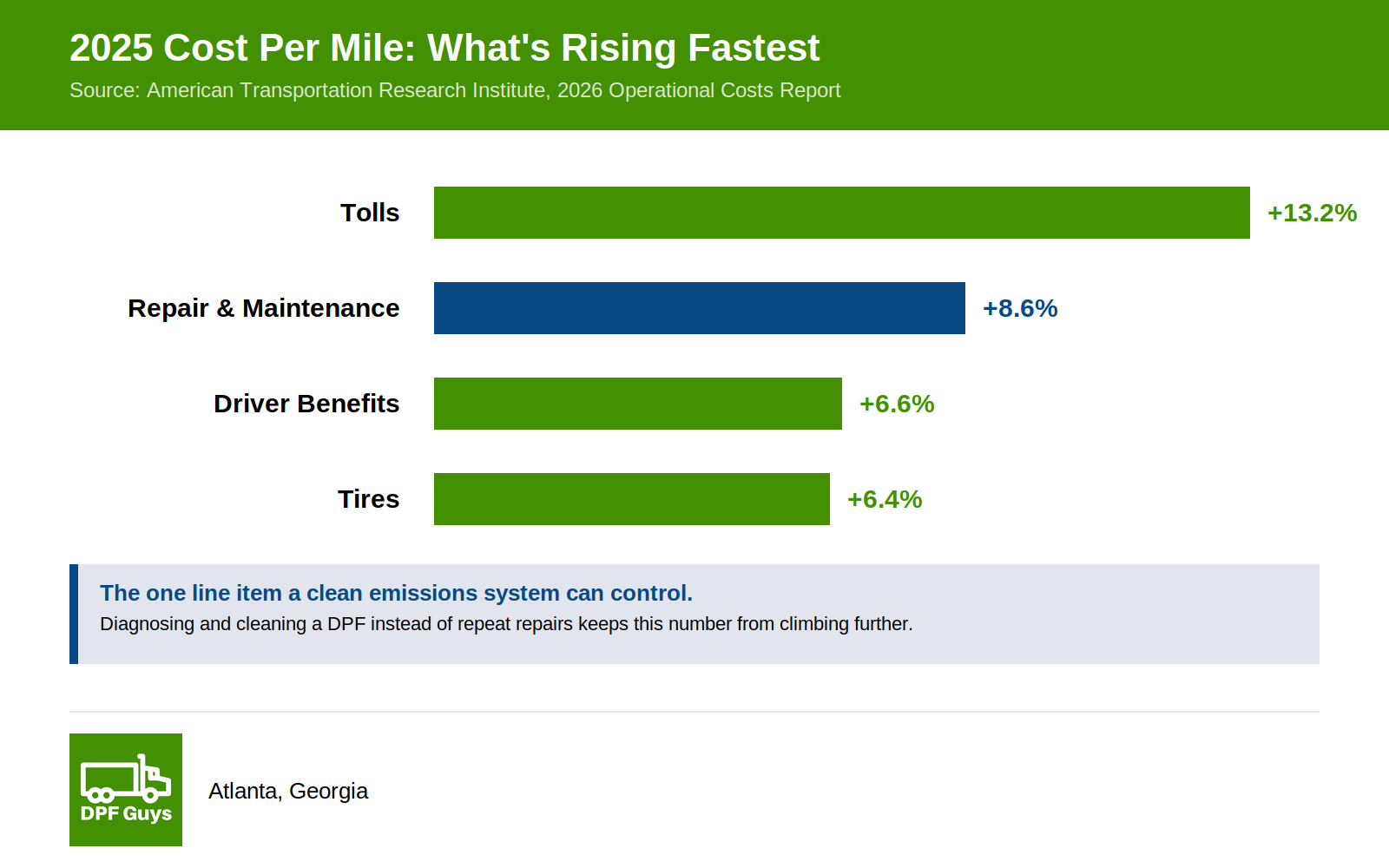
Four line items drove most of that increase:
- Tolls, up 13.2%
- Repair and maintenance, up 8.6%
- Driver benefits, up 6.6%
- Tires, up 6.4%
Two line items are notably absent from that list, worth naming so the picture is complete. Fuel rose just 0.2% for the year, well under the 2.7% inflation rate, so it isn’t what pushed the number up this time, even though it usually gets the blame first. Insurance premiums climbed 3.9%, a real increase, but a smaller one than tolls, repair and maintenance, driver benefits, or tires.
That’s the full-year 2025 picture, and it isn’t holding steady into 2026. ATRI’s early first-quarter data shows costs already running 2.2% above the 2025 average. Fuel is a big part of why, up 5.9% in the first quarter alone after sitting nearly flat all last year. Insurance accelerated too, up 6.4% in the first quarter, well past its 3.9% pace for the full year before it. Tolls and driver benefits kept climbing as well. Nothing in this report suggests 2025’s record year was a peak.
Tolls and driver benefits are largely out of a fleet’s hands. Repair and maintenance isn’t. That line item is the one most directly tied to how well a truck’s engine and emissions system are actually running, and it’s also the one where a fleet has the most room to push back against the trend instead of just absorbing it.
Where the Repair Line Actually Comes From
Most shops treat a check engine light, a derate, or a failed regen as the problem itself. It isn’t. It’s a symptom. A clogged filter, a fouled sensor, or a fuel system running dirty is usually the real cause sitting upstream, and until that gets addressed, the truck keeps cycling back into the shop for the same repair line, over and over, at full price each time.
That cycle is a big part of what shows up in ATRI’s 8.6% increase. A fleet that keeps treating symptoms is paying for the same underlying problem repeatedly instead of once.
The Fix Nobody Budgets For
DPF Guys exists specifically to break that cycle. Instead of routing a customer straight to a filter swap, DPF Guys diagnoses what’s actually happening in the exhaust system first, cleans and restores the filter when that’s the fix, and only replaces hardware when cleaning genuinely won’t solve it. That distinction matters more than it sounds like it should. A cleaning is a fraction of the cost and downtime of a replacement, and a truck that’s cleaned before the filter is fully packed with ash stays out of the shop longer between visits.
This is also where a growing part of the country gets easier access to that same approach. DPF Guys is building out a franchise network so the same diagnose-first process is available regionally instead of requiring every fleet to ship a truck or a filter to Atlanta. For fleets specifically in the Atlanta area, Clean Air Fleet’s additive line is also available for pickup directly at DPF Guys, no shipping involved.
Attacking the Same Line Item From the Other Direction
Repair and maintenance costs don’t start at the shop. They start with what’s running through the engine and fuel system every day. This is where Clean Air Fleet’s additive program fits, treating the fuel and oil so the emissions system has less soot, carbon, and contamination to deal with in the first place.
The mechanism is straightforward. Purified fuel and oil burn cleaner, which means less soot packing into the DPF, less carbon buildup on injectors and turbos, and less strain on the whole emissions path. Better combustion also lowers cylinder temperatures and NOx output, which translates directly into less diesel exhaust fluid burned per mile. That matters more than it sounds like it should. Most SCR-equipped trucks consume DEF at roughly a 2% dosing rate, about 2 gallons of DEF for every 100 gallons of diesel burned, so anything that lowers NOx output at the source reduces how much DEF the system has to inject to stay compliant. None of this replaces a properly functioning DPF, but it does mean the filter, the EGR system, and the sensors around them aren’t working as hard, which is exactly the kind of preventive step that keeps a truck out of the 8.6% repair and maintenance increase instead of contributing to it, and it’s also where the reduced downtime comes from, not just cheaper fuel.
What that’s worth depends on your own numbers, so run the math against your own fleet. At 120,000 OTR miles a year and the current national average diesel price of $4.57 per gallon (EIA, week of July 6, 2026), a 0.5 mpg gain from cleaner-burning fuel plays out differently depending on where a truck’s mileage starts:
- 6.0 mpg baseline, gaining to 6.5 mpg: about 1,538 fewer gallons a year, roughly $7,030
- 6.5 mpg baseline, gaining to 7.0 mpg: about 1,319 fewer gallons a year, roughly $6,030
- 7.0 mpg baseline, gaining to 7.5 mpg: about 1,143 fewer gallons a year, roughly $5,220
Swap in your fleet’s actual baseline mpg, annual mileage, and local diesel price, and the dollar figure will move. The direction won’t. Fewer gallons bought for the same miles run, plus less DEF burned doing it.
Combined with the diagnostic and cleaning side of DPF Guys’ own service, the additive program addresses the two ends of the same problem: what’s causing wear, and how to fix it once it’s already there.
The Number That Actually Matters
$2.336 a mile is not a target. It’s the industry average cost of keeping a truck moving, calculated across every mile it runs, loaded and deadhead combined. A rate that only covers the loaded miles and ignores the empty ones isn’t covering cost at all, it just looks like it is until the deadhead miles get averaged in.
That’s the number every fleet and every owner-operator should be checking their own blended rate against, and it’s worth checking against a moving target, not a fixed one. If your rate was clearing $2.336 a year ago and hasn’t moved since, it likely isn’t clearing cost today, given costs are already running 2.2% above that baseline in early 2026. If what you’re actually clearing per mile, loaded and deadhead averaged together, comes in under the current number, you’re not slowly losing ground. You’re paying to haul freight. Owner-operators feeling squeezed by this exact math aren’t imagining it. The industry average moved against them this year, and it’s still moving. The line items most within their control, repair and maintenance chief among them, are the ones worth fixing first.
The Other Side of the Ledger
ATRI’s report also noted that driver compensation crossed $1.028 per mile combined for the first time. Fleets are already stretched thin on labor cost, and adding unnecessary emissions system repairs on top of that is the one part of the equation that’s genuinely avoidable. A fleet that keeps the same truck on the road longer between DPF services, and burns less DEF doing it, isn’t just saving on one repair. It’s holding a line item flat while the rest of the industry watches it climb.
That’s the case for pairing the two approaches instead of picking one. Diagnosis and cleaning fix what’s already gone wrong. The additive program slows how fast it goes wrong again.
Where This Leaves You
None of this is complicated. Repair and maintenance is the one line item in ATRI’s report that responds directly to how a truck is diagnosed and maintained, not to tolls, not to insurance markets, not to driver labor costs. A fleet that treats the emissions system as a symptom to chase keeps paying the 8.6% increase over and over. A fleet that diagnoses it properly, cleans instead of replacing when cleaning is the right call, and treats the fuel and oil going in, keeps that line item from climbing in the first place.
DPF Guys handles the diagnosis and the cleaning, with a growing franchise network making that easier to reach regardless of where a fleet is based. Clean Air Fleet handles the other half, treating the fuel before it ever reaches the emissions system. Order Clean Air Fleet’s additive line directly to start on the upstream side, or reach out to DPF Guys for the diagnostic and cleaning side. Either way, the goal is the same: keep your blended rate above $2.336, not just close to it.
Frequently Asked Questions
Does a diesel additive replace the need for DPF cleaning?
No. An additive reduces how much soot and contamination reach the filter in the first place, which extends time between cleanings, but a DPF still accumulates ash over normal use and needs periodic service regardless of fuel or oil quality.
How much of the 8.6% repair and maintenance increase is emissions-related?
ATRI’s report doesn’t break the repair and maintenance category down by system, so that figure can’t be isolated from the top-line number. What’s documented is that emissions system repairs, DPF service among them, are a recurring and often repeat-visit cost category within that line item.
Is $2.336 per mile the most current number available?
It’s the most current full-year figure. ATRI’s annual report always covers the year that just closed, so 2025 is the newest complete data set as of mid-2026. The report’s own first-quarter 2026 numbers show costs already running 2.2% above that 2025 average, so the trend is still climbing, not leveling off.
Is the Clean Air Fleet additive available outside Atlanta?
Yes, through Clean Air Fleet’s dealer network and online ordering. DPF Guys offers local pickup for Atlanta-area customers specifically to avoid shipping costs.